

Young Sherlock: The Advent of the Understood Villain
No name quite stands out in the crime-solving world as that of Sherlock Holmes. Over the span of nine books, Arthur Conan Doyle managed to write Sherlock Holmes, along with his partner, Dr. Watson and his nemesis, James Moriarty, into the hearts of Western civilization. Since then, a constant stream of approved novels and shows has continued to expand his reputation. One of these shows is called Young Sherlock.

Directed by Guy Ritchie, known for his normally fast-paced films, but also his ability to slow down at times [films of his include Snatch (2000), The Covenant (2023), and the live-action Aladdin (2019)], paired with a brilliant cast, this TV series stood out in my mind for a few reasons.
First, the plot was genuinely intriguing and at times unpredictable. It follows a young Sherlock Holmes (played by Hero Tiffin) through a crime/murder solving spree. Starting at the prestigious University of Oxford, where his brother Mycroft Holmes (Max Irons) managed to get him a job as a scout (something like a college servant) after he fell out of favor with the law, he quickly became friends with James Moriarty (Donal Finn). Interestingly, as already mentioned, in the books this is Sherlock’s arch-nemesis, a genius without a soul, as Doyle puts it, but in this show, Moriarty plays the role of refining Sherlock’s wit.
And so it begins.
Sherlock Holmes, along with James Moriarty, are unsurprisingly caught up in the deaths of multiple professors, a veritable murder mystery. Along the way, a Chinese princess, Holmes’s mother (residing in a mental institution), his father, and a plethora of other characters are introduced, coming together to weave a wonderfully interesting narrative.
Second, the script is simply delightful. Interactions between Sherlock and his brother Mycroft ought to be studied and emulated, and even the general level of dialogue is high above what I am used to finding in most, if not every movie or TV show I have watched. This was undoubtedly one of my favorite aspects, and it was where I thought this show completely triumphed. I have no other words to describe it, except to say that I loved the script.
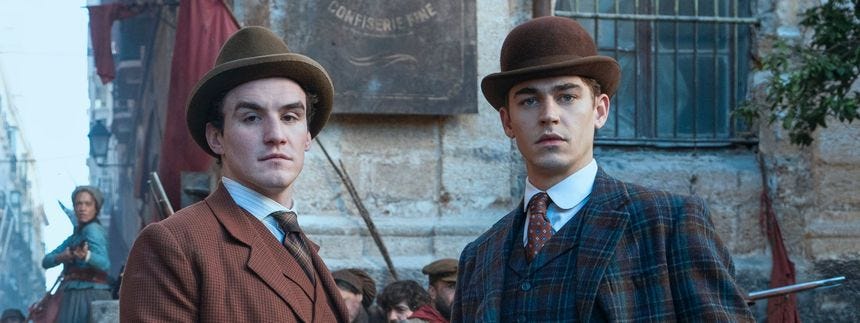
Third, the supporting actors were phenomenal, particularly Donal Finn as Moriarty. He has been called a “show-stealer” by many critics, and I completely agree. I also personally enjoyed the character Mycroft Holmes (played by Max Irons). He longs for advancement in the British Bureaucracy, but his family comes first. In the first count, he is his father; in the second, his mother. He is stable throughout the show and demonstrates the remarkable first-child tendencies; he really is his mother’s boy. Those two are all I’ll mention for the sake of word count, but there were many more that provided just as much depth.
And this brings me to number four. The villain. And in the case of this show, the understood villain. Let me do a little explaining.
In my mind, the most common theme among villains is writers making them misunderstood in an effort to understand them. A little bit paradoxical if you ask me. And for this reason, it just doesn’t resonate. It is off. It tries to shift responsibility and to make the audience feel pity for a character who was/is otherwise meant to be deplorable. But in Young Sherlock, the villain, the mastermind, is unrepentingly a Darwinist. There is no misunderstanding. It is survival of the fittest drawn to its logical conclusion, then put into a person. For this person, ethics have no meaning; dog eats dog. What has to be done to secure your status will be done; analytical and domineering opportunists and plotters take the stage, oftentimes with a little too much Machiavellian principles in them for my taste. After all, isn’t it better to be feared than to be loved? And in the show, Sherlock comes to understand this, albeit after he unravels a web of lies that had ensnared him. But what a relief this is.
There is only relational pity for the villain. The villain’s greed is his driver, the world his stage, and the people his puppets. But if you have too many strings to control, one will eventually escape your grasp.
Enter Sherlock.
Interestingly enough, seeing atheism and Darwinism drawn to their conclusion is quite pitiable; I experienced the same frustration when watching the Marvel film Black Panther: Wakanda Forever. The main character has moments when her atheistic beliefs are on display and she says that her desires, her wants, are all that matter, everything else be damned. I digress; they just don’t seem to understand that you can never be the top dog. And in most cases, the man who is loved and who has a foundation that supports him, rather than one built on lies, will be their undoing. And so I present a significant achievement, in my mind at least, of the TV series Young Sherlock: the understood, and the understandable villain.
A little rehash: four things that stood out to me. The intriguing plotline, the delightful script, the thrilling supporting actors, and the emergence of a well-defined villain. In short, I loved this show. Sitting down in the evening to watch it with the older contingent of my family was the highlight of my week or so. But I probably would suggest 14 and up for Young Sherlock.
Now, I am no professional critic; I find most of them to be nitpicky. So I decided to present the things I enjoyed about the show, because it was enjoyable and worth my while. And I sincerely encourage you to also make time to watch Young Sherlock. I think that you will find yourself both charmed and entertained.
Get this man a substack!
Well done, Ezekiel.