

We begin today the Advental journey to Christmas morn! Dietrich Bonhoeffer captured the spirit of the season well: “The celebration of Advent is possible only to those who are troubled in soul, who know themselves to be poor and imperfect, and who look forward to something greater to come.” For this spirit to capture us, we must know what Advent is. We cannot enter this season proud. We need to be expectant that our hearts will long well and knowingly.
If you are experiencing this season for the first time, you need to know that Advent is not “Christmas-lite.” It is not a preview or a warm-up. It is preparation. We may say that it is a holy longing before holy joy. We don’t leap into Joy to the World because Joy-Incarnate has a long prophetic history prior to his arrival. Likewise, we don’t rush to Luke 2 without first walking through the Magnificat of Luke 1, sharing in Mary and Joseph’s travail, and learning to “go tell it on the mountain” like the prophets of old.
The Two Senses of Advent
In theology, we speak of the Advent of Jesus in three senses:
His first coming in Bethlehem
His continual coming into our hearts by the power of the Spirit
His second coming at the end of history.1
In all these ways, we retell the story of the Messiah whose arrival reshapes the world (cosmically) and God’s people (personally)
Advent marks the beginning of a new Church year, because it is the culmination of a past event, a mighty presence, and a glorious coming again of our Blessed Lord. In the new church year, we once again walk the dark corridors of expectation—joining Israel in the long wait for the fulfillment of prophetic promises and the rise of a new King who conquered, conquers, and will finally conquer all the hearts of men.
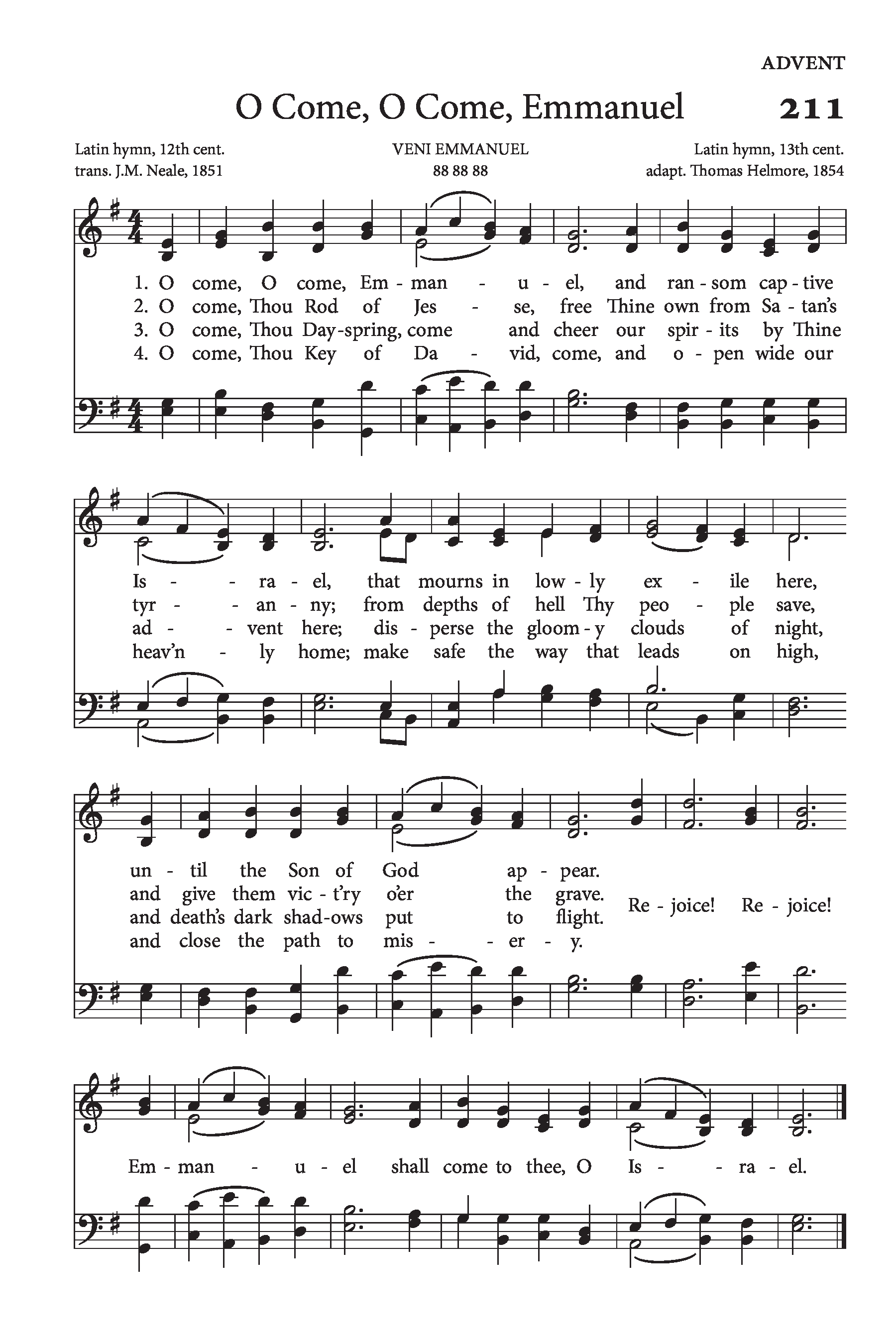
Much of this advental expectation will bear fruit in the hymnody of Advent. For nearly seven centuries, one hymn has carried this longing with unmatched force: the ancient Veni Emmanuel—O Come, O Come, Emmanuel.

I encourage you to sing this Advent classic throughout the week. Don’t sing it with great hurry. You may wish to pause and meditate after the end of each verse and then move on to the others. Enter into the song as those who sat in darkness for generations, longing for the long-expected Messiah.
Two Promises in the Hymn
But how does this great hymn instruct us?
First, we sing that Christ’s coming will “Free Thine own from Satan’s tyranny.” Advent reminds us that the arrival of Jesus destroys the works of the devil and reclaims what belongs to Him. The house of creation lay under the bondage of the evil one, but Christ comes to liberate His household from captivity. The hymn announces that Satan’s tyranny has been broken and that the birth of Jesus inaugurates a new era in human history.
Second, the final verse proclaims, “Make safe the way that leads on high, and close the path to misery.” Here we confess that Jesus has burst open the gates of heaven for all believers. He came to rescue those exiled and imprisoned under the dominion of darkness. His coming ends the misery of perpetual expectation. Our waiting is finally over.

Imagine if we only longed and never saw fulfillment—if it were always winter and never Christmas. But Jesus’ arrival brings our waiting to an end and opens heaven to all nations. Christmas is coming. The path of misery ends where the path to the newborn King begins.
For these reasons—and countless more—we enter this season with great hope. And so we sing with longing, yet longing fulfilled: “O Come, O Come, Emmanuel!”
You can think perspectivally about this: His first coming is the normative (grounded in time); his continual coming is the existential (personally and practically); and his coming again is the situational (time and history)
Wonderful! Thank you for this awesome reminder of the Savior who came, comes and is coming again!