

I have argued that soccer is un-American because it draws a multiverse of ideologies; it is too universal to fit into the American cultural ethos of apple pie and southern hospitality. America is a national project. Soccer claims too much. In fact, something like 3.5 billion viewers are absorbed into its liturgy. I still think it’s un-American even as I sit hypnotized by its beauty.
While I think it conflicts with true Americana pathos, it should nevertheless be enjoyed as a dance or as a beautiful aria. Americans are not predisposed to love opera or waltzes, though I think they should. Maybe my proposal is that Americans love futebol as a stamp collection, as your grandpa did. Stamp collection is not intrinsic to the American spirit, but it does add charm to it.
An Ode
So, give me a couple of minutes to feast linguistically on the game played with a solitary ball.
To put it simply: I think there is no sport like it! It’s samba in motion; poetry of the bones. There is a kind of choreography to it, a waltz of bodies moving with incredible precision. The characters move according to a pre-planned agenda. And then, like a lion over her prey, she strikes with her inimitable splendor and achieves her intended goal…literally. Ok. I think you get my romantic inclinations towards futebol.
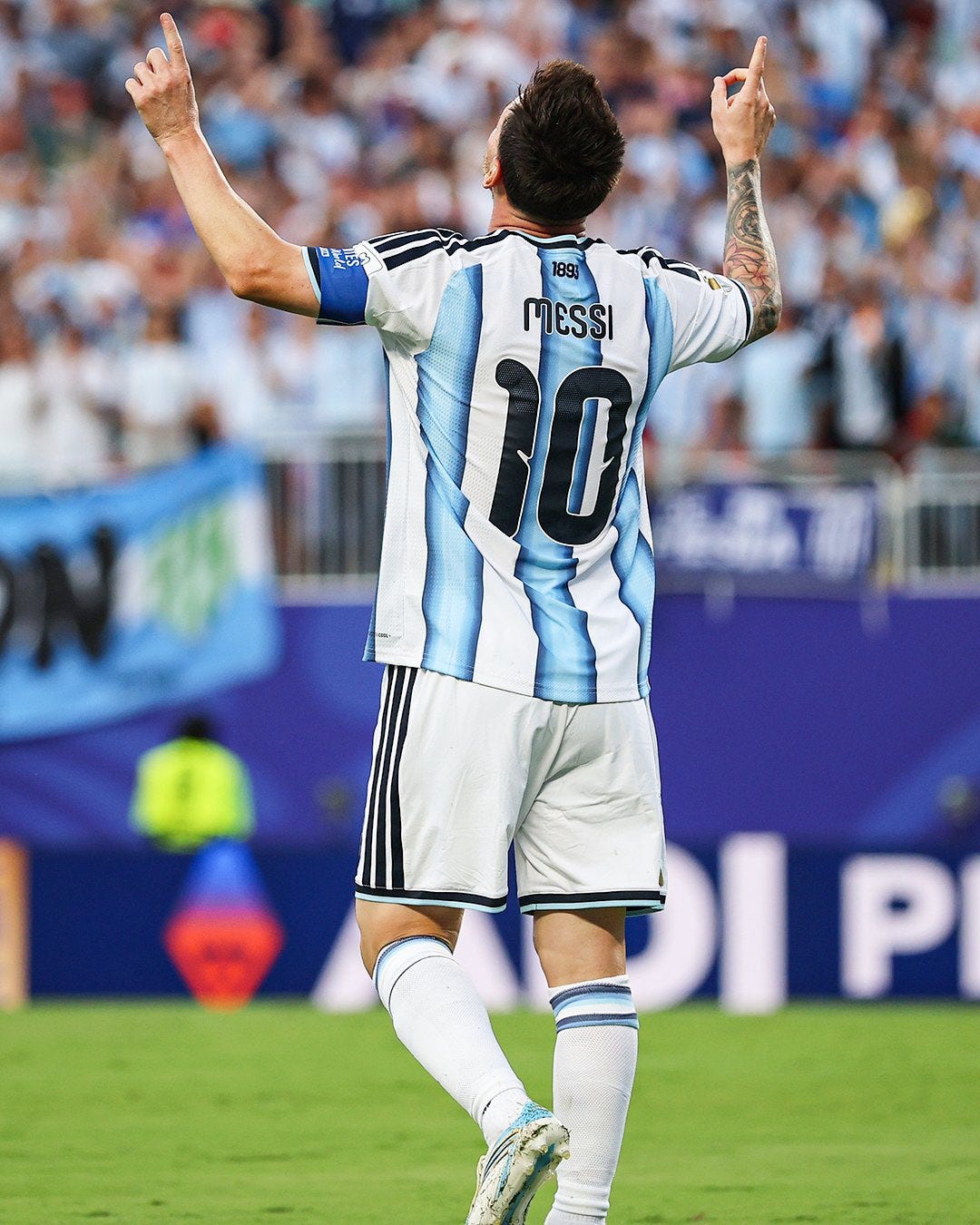
My complaint is not with the beauty of the thing. I have loved its glory since I was three, or so my mom says. My complaint is with the world, which often gathers around itself. I don’t think it’s good or healthy to babel-ize a sport. Or, maybe to megachurch an event.
As I write, my feed shows me a 38-year-old man who has scored five goals in two games. Zeus’s place in Greek mythology is now severely threatened by a hobbit-sized Argentinian named Lionel Messi.
There is a reason soccer feels less like a sport and more like a global language. There is a reason it catches the American spectator by surprise every four years for its meticulous movements, and then vanishes to the sidelines for the other 48 months. We can feast in its pauses, crescendos, false resolutions, tragic mistakes, and moments of near-liturgical ecstasy. Imagine a pass through the narrow gate, a Messi-like strike (unassumed by the fiercest defender) from impossible distance—these are not merely athletic actions; they are aesthetic events. Pelé, Garrincha, Maradona, Messi. Brilliance. Natural. Sublime.
One can oppose the cathedral's ideology while still admiring the stained glass. That’s the dance that I have loved for almost half a century. And that’s honestly the seeming contradiction I find myself in.
And perhaps that is why soccer is so dangerous and so delightful. It does not merely entertain; it enchants…but enchants at a universal level. It invites the nations to sing from the same hymnal, even if no one agrees on the god being worshiped. Shakespeare’s line comes to mind: “If music be the food of love, play on.” There is music here, no doubt. But music, like liturgy, always forms the soul.
So, even though I grant that it is not in America’s best interest to adopt its dance (for the reasons I mentioned in a previous essay), I reserve the right to admire the spectacle that gathers the world so easily and baptizes its unity in soccer fields across the globe. It conquered me ever since my goalie days near the favelas of northeastern Brazil. And it still conquers me, though I have been removed from that world for over 30 years.