

My youngest son sat me down on the couch a few days ago, looked at me with utmost seriousness, and asked, “So, how did you decide to become a pastor?” After spending years answering that question and offering guidance to grown adults, I confess I was a bit lost trying to articulate my story to a curious 9-year-old. His sincerity caught me off guard, and in one of the few moments in my life, I struggled to answer a question deeply embedded in my DNA.
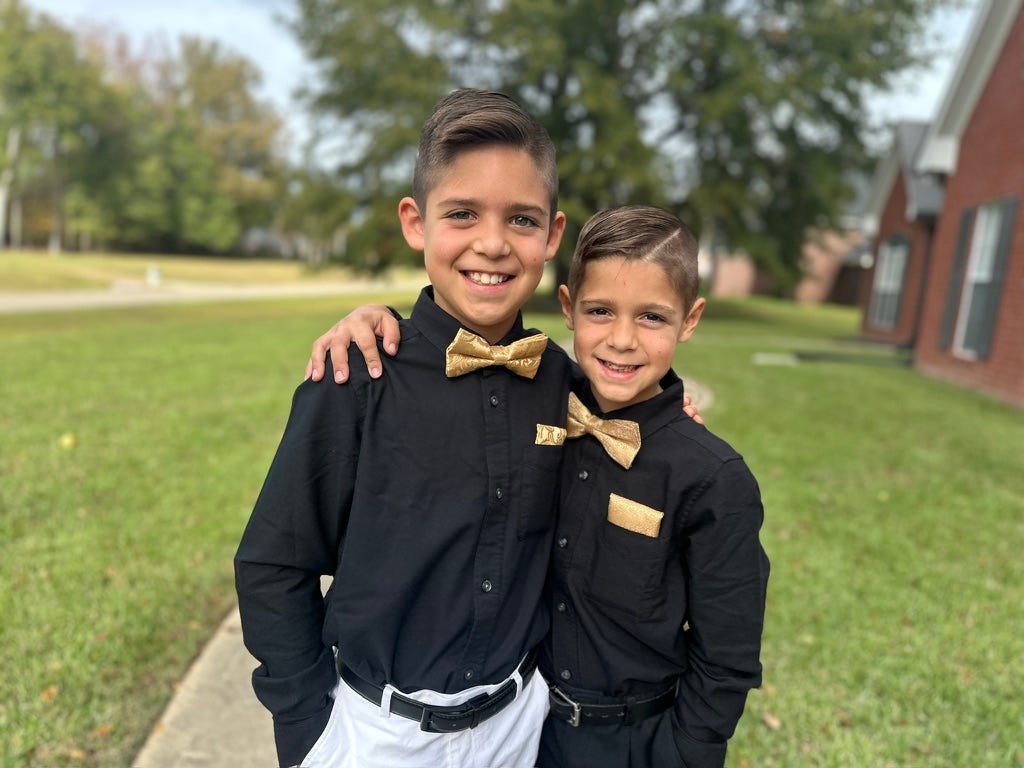
Also, a happy birthday to my precocious nine-year-old!
So I shared some thoughts about a Brethren pastor who pulled me aside after I shared my testimony in 1998. He said, “You should consider the ministry.” And that was the birth of my pastoral search. Then I told my son that I loved people, and loved hearing their stories, and loved speaking God’s truth. He seemed content with my explanation. But then I realized I hadn't yet elaborated on it publicly at any level, and while my story is unique in some respects, it will likely resonate with many pastors or those pursuing a call into the life of the Church.
So, here is a bit of my journey into pastoral work divided into three parts. Some of it is autobiographical, but you can’t take the personal from the Person of God who put me into the story. In part one, I will focus on the years preceding my return to the United States.
Early Years
I grew up in a pastor’s home. My early years left few memories of my father’s pastoral and pulpit ministry. He was a well-known pastor in Northeastern Brazil, part of the General Baptist tradition. At the time, it was a fairly rigid form of Christianity akin to the American Independent Baptist movement (think Pensacola Christian College and Bob Jones University). My father was somewhat repulsed by that movement's cultural ethos. In fact, I don’t recall him making those distinctives overly preeminent in our congregation. He was a fundamentalist at heart, but that fundamentalism generally stopped at the doctrinal level, and not at the practical one.
In fact, perhaps the opposite was the case. The music in our congregation was relatively contemporary, with some hymns thrown in, but with guitars leading the way into the garden alone (let the reader understand). And I should know because I was already singing in the praise band long before I ever picked up a guitar. Yes, according to testimonies, my volume was on display since I was 12.
My father was a man of conviction. There are gaps in my memory. I still don’t know why. It may be because I left Brazil so early, but I do remember his storytelling and jovial way about him. Unfortunately, there are no recorded sermons of his from that era. We lived in a poor town, and possessing some microphones was already quite an achievement. I don’t think recorders were common in the 90’s where we lived. That same congregation still exists. And occasionally I glance at their Facebook page to watch a few minutes of their service.
All of this to say that, unlike many of the great preachers who received some form of mystical calling in their childhood, I was not one of them. I knew my father was a pastor, and a few of his brothers were too, but it never dawned on me that I would follow in their footsteps. Again, I didn’t fall off a horse, nor did I hear Hebrew words from heaven. Maybe God offers divine and mystical experiences only to the Billy Grahams and Pauls. I think I have said before that watching my dad undergo ecclesial battles, rough counseling sessions, and some health problems towards the end of his life did not inculcate in me a desire for pastoral ministry.
My father died in 1996 when I was 16 years of age. It was quite a shock. I remember one Saturday evening a friend of the family driving us to youth group and then heading to the hospital to drop off my dad, who was complaining of some pain. I honestly don’t remember my last words to him. But days later, he had a heart attack, and the next thing I remember, we were all gathered in an American Missionary’s home. Everyone was weeping. My mom was uncontrollably sobbing, and for some reason, I don’t remember crying until that evening when everything began to sink in. At 16, I thought anyone over 30 was too old, but even then I remember thinking that at 41, my father was indeed not old at all. But now, he was dead. And as the oldest in the family, I knew that much was going to change.
Translating In the Days of the Titanic
After my father died, I was awakened. Suddenly the world of beach volleyball—something I had been pursuing for some time—became tertiary in interest. I realized at that moment that there was something far greater ahead; something that would demand more of me than treading through beach sand.
I didn’t know what that thing was, but it became clear that my father’s commitment to speaking English at home once we returned to Brazil would open many doors. You can find a little of that story here:
My mother was the visionary in this endeavor. She saw that I could teach somewhere. And at the age of 16, that opportunity arrived. I applied for a position at a local private school where students were eager to learn English. My students were quite eclectic—from doctors to lawyers to nurses and ordinary kids. I chose the Titanic subtitle because it was the era of Celine Dion and her soundtrack, My Heart Will Go On. To say it was just a song minimizes its impact on Brazilian culture. While the United States looked thrilled to introduce two young actors (who would eventually become movie icons) to the big screen, Brazilians looked back into their bloodline to see if anyone had any remote connection to DiCaprio. When someone found a connection reaching back a few hundred years, they would be interviewed and treated as heroes.
The kids in the classroom also wanted a fresh translation of such “masterpieces,” treating it like Homeric work fresh with new insight. And I was the translator par excellence. The professionals in the room were also enthusiastic about translating words that ultimately meant a load of nothing layered by more nothingness.
Translating in the age of Titanic was precisely what I needed to increase my bank account. Yes, indeed, more noble work was done in the classroom, but adverbs and adjectives did not make the cut. It was pop-music translation that did. And I am thankful for those two years of teaching.
Evidently, the money I had been depositing into a savings account did quite well in those 24 months. My mother wanted me to know it was time to do something with it. I had the idea of a vehicle. At the time, I was 18, and I was tired of taking a bus every day. My mom had another idea. She suggested I go back to the U.S. And so, after a lot of networking, I arrived at Pittsburgh, PA, airport in the summer of 1998, and began my life in a town a couple of hours away called Altoona, PA.
Warning: cliffhanger 😊.
This could be a movie. (Who would play you?)
I was so engrossed I forgot this was Part 1. *sigh*. Looking forward to Council in a few short weeks my friend!