

Happy Epiphany!
It doesn’t have the same ring as “Merry Christmas” or “Christ is risen!” but Epiphany carries significant repercussions for our Christmas and Easter theology. In some sense, Epiphany is the key that unlocks both classic Christian festivals. Epiphany secures the triumph of Jesus’ life and mission.
In Epiphany, we celebrate the “manifestation” of Jesus to the Gentiles. When the Magi came to give him gifts, they gave him gifts as a foretelling of the great gift the Son will give the Father at the end of history (I Cor. 15:24-26). When Christ returns, he returns with the kingdom as a gift to the Father. Jesus receives gifts, but he is the great gift-giver of history (Eph. 4:11-13).
Jesus introduces himself to the Gentile world as a fulfillment of Simeon’s song. He is a light to lighten the Gentiles and the glory of Israel (Matt 2:1-12). Jesus’ entire ministry is a ministry of gift-giving, culminating in his body being given for his people (Lk. 22:19). Indeed, gift-giving is a crucial component of Jesus' revelation to the world.
We can be sure of the fulfillment of the Great Commission (Matt. 28:18-20) because Epiphany’s gifts to Jesus are gifts that will be dispersed among men. Jesus is the unfailing gift-giver to the nations. He has never failed to provide for his people. He promises to be a “light to lighten the Gentiles, and the glory of thy people Israel” (Luke 2:32).
For the Christian, Epiphany signals a season of discipleship through gift-giving rituals. The entire biblical premise of sanctification entails a life of exchanges—my life for yours.

Christians are called to think through their ordinary rituals and adjust them accordingly to reveal Christ’s work to the nations. We can consider three questions to build a gift-giving environment in our homes and churches:
First, how can my home be a gift of refreshment to my children and those who enter it? Have I made my house a house of prayer? Is it perfumed with the aroma of heaven?
Second, how/what are my daily habits? In what ways are those rituals bringing life to my own soul and those around me? Am I refreshing my spirit to refresh others in the hope of the Gospel?
Third, how am I being an ambassador of Jesus in my endeavors? How is my private and public life sharing the mission of Messiah to the world? Is my life manifesting glory in my community?
Epiphany means to make known what was hidden. Christ’s presence was a mystery to the Gentiles, but now his life is made known to the nations as a babe and as the Creator of the cosmos.
Epiphany summons us to wrap our lives as gifts to those around us and to be constantly on the lookout to give of ourselves to others out of the abundance of gifts we have received from Christ, our manifested Lord.
Athanasius Youth Conference
Thanks to everyone who prayed for me in the brief whirlwind of a drive to Orlando this past week. My son and I drove 18 hours (with stops) on January 1st and spent 6 hours in Orlando. We had a wonderful time, and I highly encourage father/son trips.
We arrived at the hotel late Thursday and went to bed fairly quickly. Then, we had our first breakfast at the hotel and concluded with a second breakfast at the conference venue. As always, I remain baffled at the lack of heavy cream in renowned coffee places in Orlando. Half-and-half won’t do it, folks!
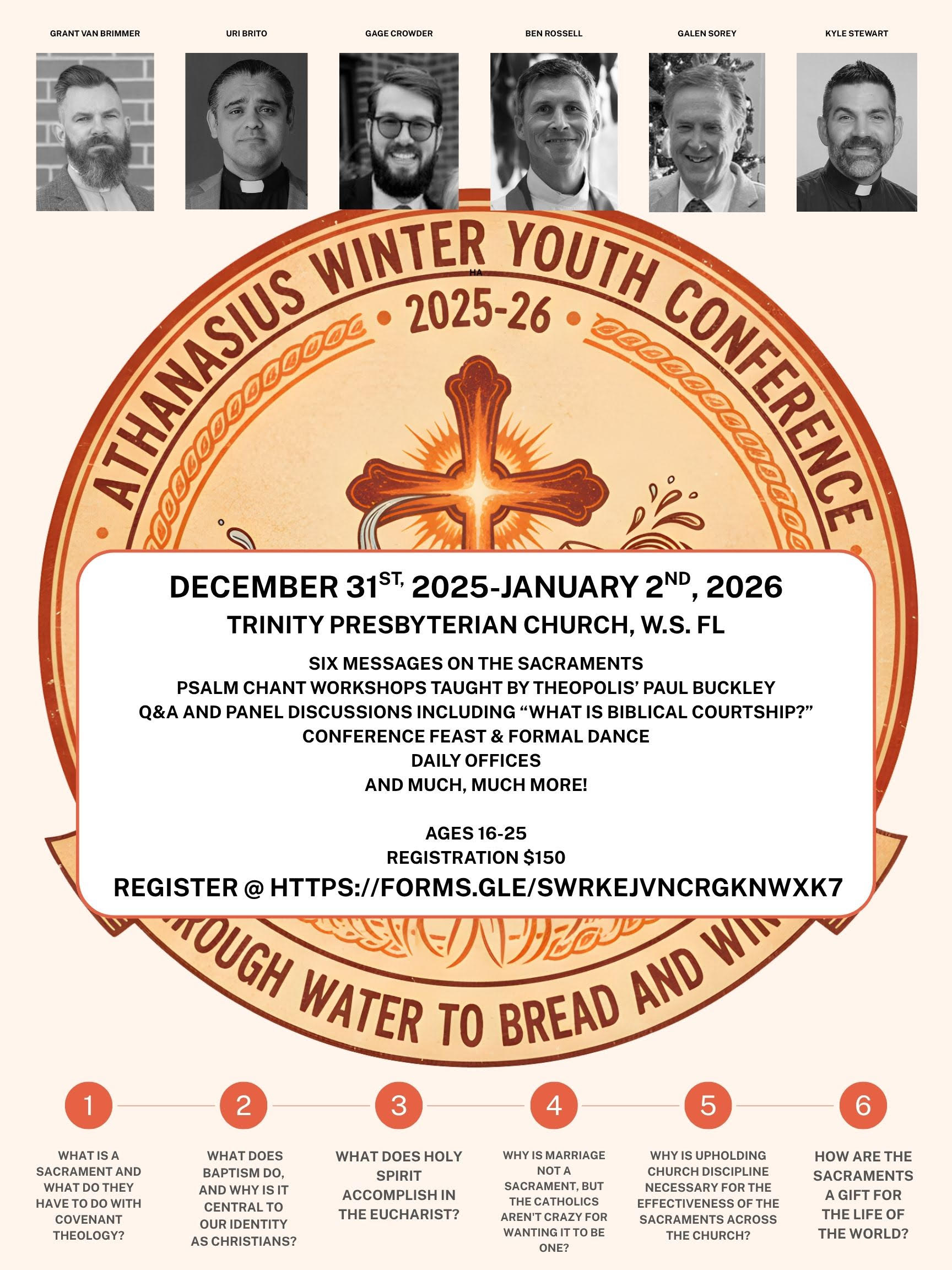
The Athanasius Youth Conference went quite well. Rev. Kyle Stewart did a great job organizing and bringing together the speakers. Apart from Pastor Galen Sorey, I was the oldest speaker at the conference, and it just so happened that all the other speakers were men I ordained or installed into pastoral ministry. The comedy of the event did not escape me.
While I was only able to be there on the last day, I still managed to hear Grant Van Brimmer speak on the sacraments and church discipline. I hope he publishes the manuscript on Kuyperian.
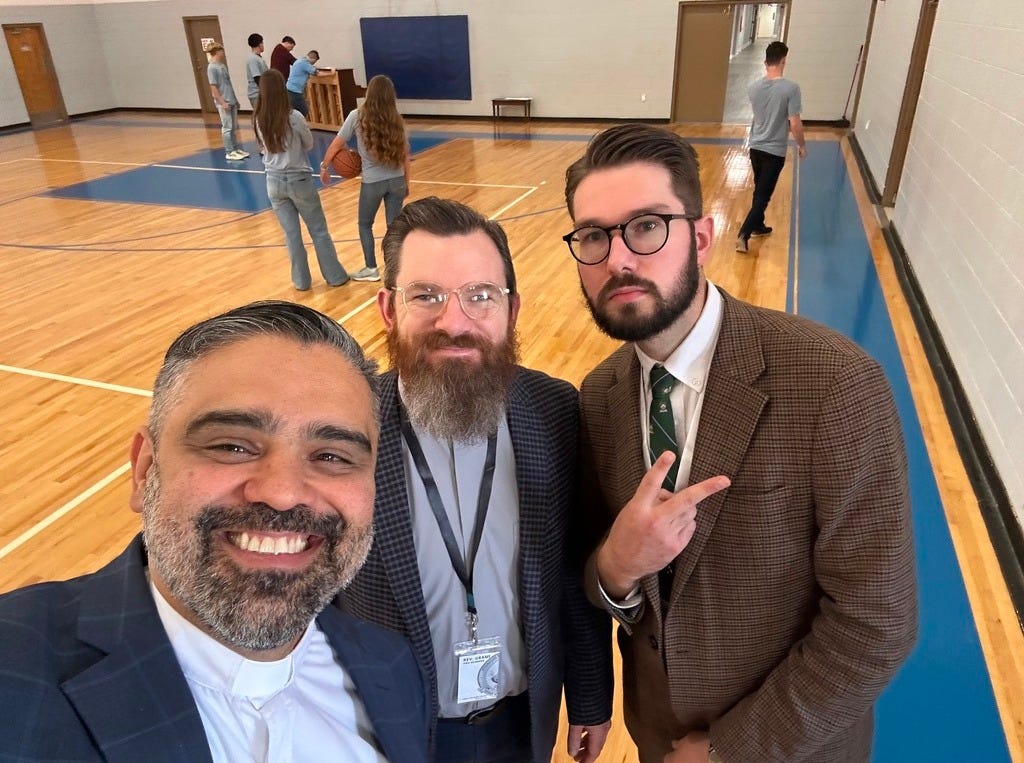
We had a panel on courtship and dating afterwards and took some questions from the audience. And then I closed the conference with a talk on the role of the sacraments in Christian counseling, a topic I believe is fairly underdiscussed or underdeveloped in my research. While there are plenty of general quotes about the blessings of the sacraments, few speak to their role in Christian counseling.
From the lecture: The Apostle Paul reminds us that “by one Spirit we were all baptized into one body…and were all made to drink of one Spirit.” Calvin comments that those who would remain in the Church must cultivate this fellowship. The deepest communion of the saints is not engineered through programming but enacted at the font and the Table.
This was the first of many conferences for me in 2026! But if it is a picture of things to come, I think God will be gracious once again with stamina and grace upon grace.
Thanks again for all your kindness in remembering us.
Notations
The Name of the Rose by Umberto Eco
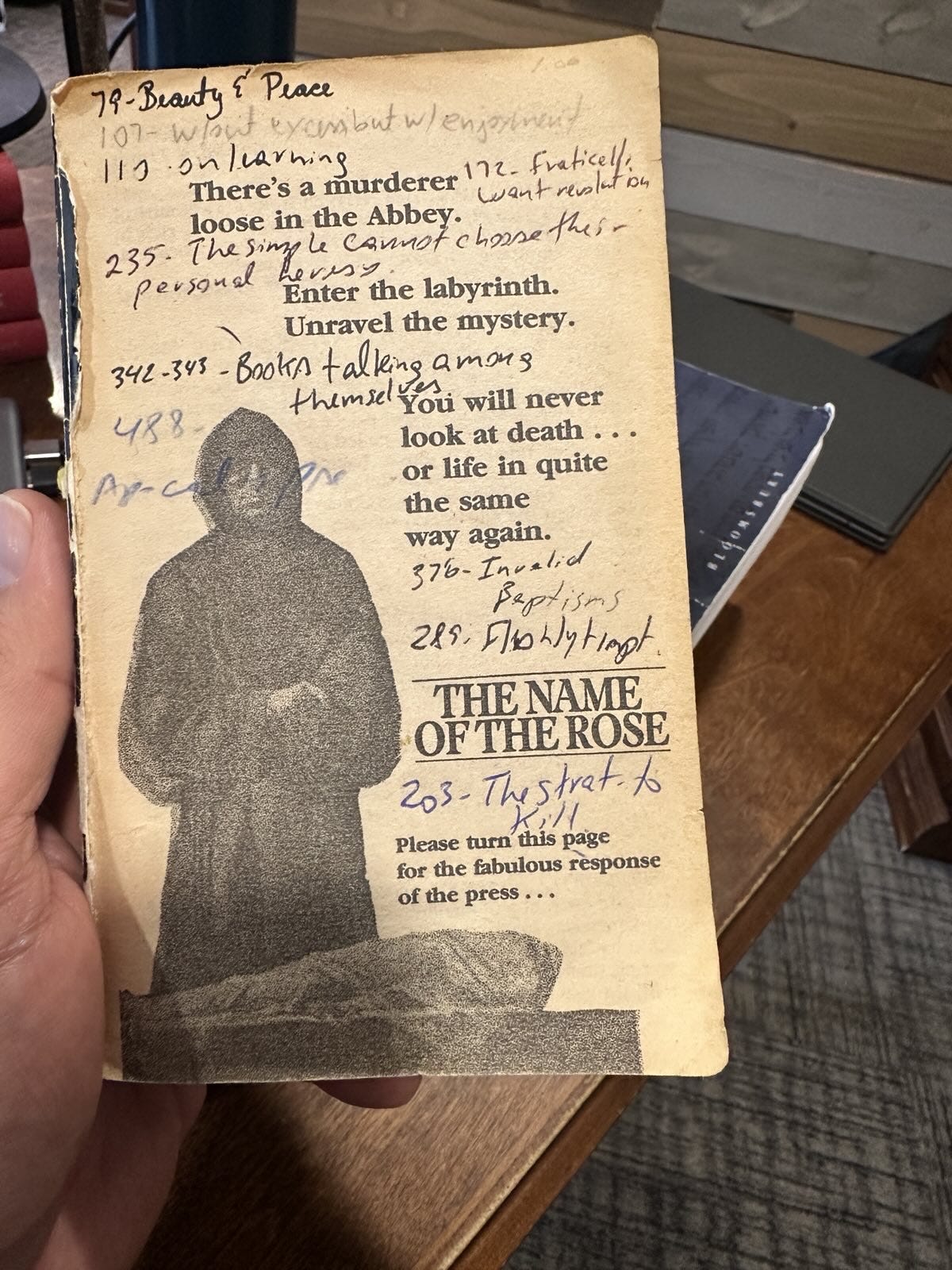
I picked up Umberto Eco through James B. Jordan, who made an astute but passing observation about the book in a 2012 lecture. I purchased the book and read it rather quickly. Nevertheless, I felt like something was still missing. The pieces weren’t fitting together, nor were the outrageously plentiful characters involved connecting in my mind. So, I decided to work through it again in November and took the opportunity to finish it in my drive to Orlando this past week. In one sense, I read the book twice, since I read it and then re-listened to it on Everand audio. The experience was majestic, and I do believe I have a fuller grasp of the extraneous details.
I can honestly say I tore this book apart:
My next task is to sit down and enjoy this masterpiece:

Uriesou T. Brito
FOLLOW ALONG
FACEBOOK / X / YOUTUBE / INSTAGRAM
PODCAST / KUYPERIAN / SUBSTACK