

What I am about to do is write a review of Theo of Golden. But the condition I have set is a limited time frame of 30-minutes to complete it. I am content if I produce something fresh about the book, but I am also happy if these serve as little appetizers for the general public. But again, the deal is if I am going to talk about this Theo fella, I only have 29 minutes left. So, here I go.
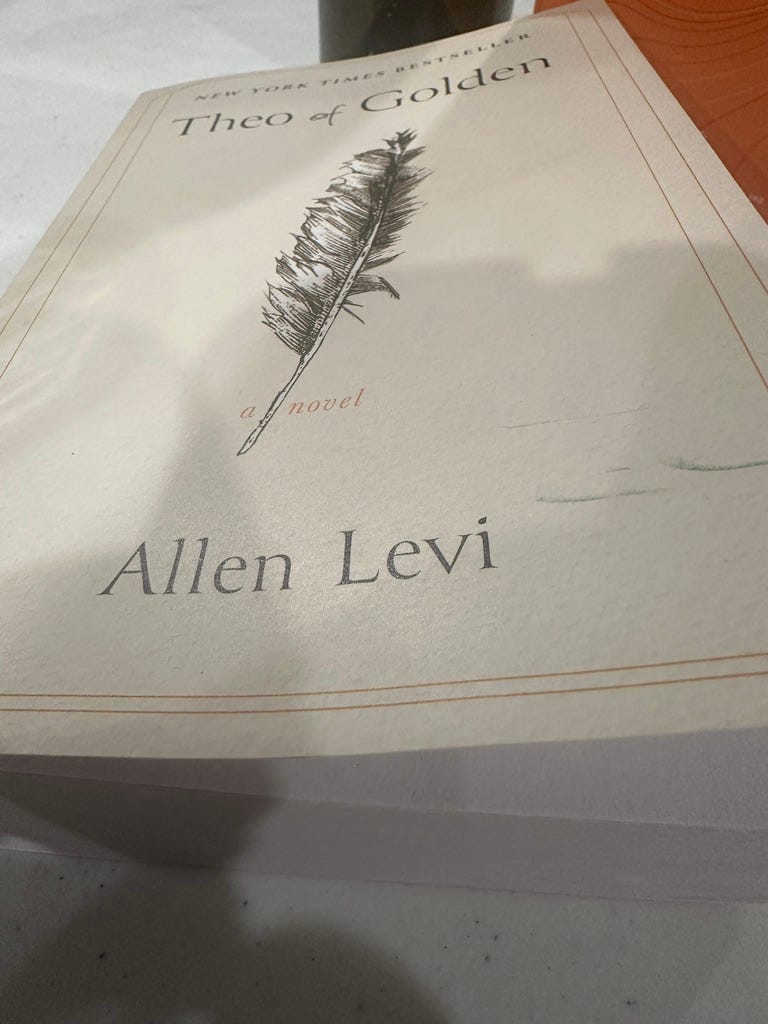
When I first heard of the book, it carried an aura of divinity. Several folks spoke glowingly of the work. I was somewhat surprised to discover that the author, Allen Levi, is debuting as a novelist. That fact did not derail my interest. So, after overhearing some passing comments about the work and being chastened by some to do so, I decided to press on. This effort received greater confirmation when my trusted deacon recommended the book for our book study.
Two and three witnesses abounded.
My desire here is not to offer the narrative of the thing, but why the thing created this narrative.
Theo as Solomon
We concluded a lovely discussion last night with some parishioners and a pleasant bottle of Port (here’s to you, Theo!). The discussion centered on various fragments of the book and some of Theo's memorable encounters with characters (Ellen, Asher, Basil, etc.). The compelling feature of Theo is not simply that he redeemed broken humans, but also that he found redemption a crucial part of his role as a human.
For Theo, the telos of life was to give, and when the giving felt sufficient, he gave some more…of himself, and then of the self he didn’t think he had. Theo (the root of Theos, for “God”) functioned as a kingly figure eager to embody wisdom. Even his place at the Ponder house was an illustration that he looked down on the affairs of man from the highest place in town.
In some ways, Theo was a man with no last name. We do find out who he is at the end, but throughout, we have no sense of who he actually is, except to say that he enters a town into which he is a complete stranger. In Golden, he begins to survey the city and detects that humans need a touch of the divine to see themselves rightly. And Theo went about this task with rapid interest to meet those needs. From the young professional female who longed to ultimately be a mother, to the musician whose life needed a transcendent sound to make sense of his own rhythms.
Theo knew that he needed to restore these saintly figures. He knew that they needed a picture of themselves, a portrait of a reality they had forsaken, a portrait of someone they had forgotten. Nevertheless, Theo gave them, themselves, a better vision of themselves, which meant their real selves.
As a solomonic figure, Theo offered vignettes and pictures of the good life; a life that is not unattainable, but one that will, however, require some earnest work to arrive at and achieve. And those who listened to Theo found a sense of belonging and being again. But those who trampled on his art faced his wrath. The 86-year-old Portuguese man overthrew tables, not because he wanted disarray, but because those who hated decency and beauty deserved to be rebuked. But those who gave beauty a chance received a new opportunity to live.
Theo as Eschatological Man
But there is one final element to note (before my time runs out): Theo is an eschatological man. He is a form of a metaphysical man who is dogmatic about his purposes. He walks into an unknown town knowing much about virtually everyone (Asher, Ponder, etc.), but he is received with remarkable skepticism by everyone. Some even doubted his motives. Others were bewildered that such a man would attempt to play the role of charity in their midst.
But once they were exposed to the man, they gained a new affection for him, but more than that, they gained an affection for the role of charity again; things that were uncertain about their futures now found good and true meaning.
And that ultimately is Theo’s role: to give those in Golden a purposeful future; to live intentionally in the task of loving and serving; even if it means being at odds with the expectations of society. Theo walks around in an itinerant fashion: healing, talking, admiring, encouraging, and exhorting. But he never walks around Golden as the chief hero. He walks around the town from space to space, redeeming every square inch dripping with wild humility and virtue. In fact, we may even say that his end is a form of cry for deliverance to those who are suffering and under the feet of oppressors.
So, this is how it ends…
I do not wish to give away the ending, but I do wish to say that Theo is a connoisseur of life. He is the traveler of old worlds, he is the appreciator of beauties, he is the lover at the dance, and he is the healer of Golden. And all these things are accomplished not through some incantation, but merely through the art of giving; through the imitative display of being: being like God, being like the true man.
Theo sees all things, again, not because he is divine, but because a life of suffering and a degree of shame, and repentance of many sorts make you and your gray hair symbols of tasty Port. So, in my three minutes remaining, I offer a toast to Theo….
To Theo, who saw the weak in their habitat and did not despise them…who saw the lonely instrument and thought, “musical notes should fly…” and who loved well unto the end.
What a beautiful, thoughtful review. And the toast at the end 💕. I loved the book and I have given out so many copies, hoping to share this sweet experience with others. If you haven’t seen any interviews with the author, I recommend viewing a few of those. Levy is a humble, ministry-minded soul.
I have been a reader for some 80 years now. I have finally learned that if I do not like a book, I do not need to finish reading it. I did not have a problem reading this book. I had a problem laying it down. I’d probably put this in at least my top five books ever.