

Not Another Version of Someone Else
As I come to the end of my three-year term as Presiding Minister of Council, I would like to reiterate some of our ideals. I know I have been repetitive these last 36 months, so to change things up, I will be liturgically repetitive this time. The reason for this is that I have no novelty to convey; I have only ideals to preserve.
While the CREC continues to grow—to be precise, 150% since 2020—it’s significant to guard our gates. Yes, we are gate-keepers! We take the cherubic Word of God and our distinct vision and seek to preserve them. Some wish to see the CREC as a big tent Reformed 4th of July party, and others wish to preserve our Westminsterian tradition with the added paedocommunion bonus. Still others would like to see a more eclectic confederation operating under “leave-us-alone” principles. The latter group has changed, adapted, or realized that it is rather too difficult to preserve a vision under libertarian worldviews.
Either way, as I have stated before, the purpose of the CREC is not to be the PCA without Tim Keller (or Kellerites) or the OPC without cranks like D.G. Hart. We reject third-wayism and dualism and Escondido-ism, but there is much more that comprises who we are. We are not some kind of GOP headquarters. Our interest is D.C., but it is also classrooms, coffee shops, and culture.
We are a communion of Reformed churches deeply interested in cultural renewal within the church and the home; as one of our founding fathers has stated, we want a theology that comes out of our fingertips. In short, we desire a liturgy that enriches God’s people with joy.
Even though our confessions, diverse yet unified, reflect our catholicity, there are identifiable distinctives that truly define us. We acknowledge that these may differ from the trajectory of other Reformed bodies, but they are the pillars of our 150+ churches. I will offer the big categories here and then elaborate on them. They are our eschatology, epistemology, and ecclesiology.
Our Eschatological Instinct
Our postmillennialism is deeply embedded in our lives. This is more than a preference for historical optimism. Postmillennialism is how we see the Bible moving. It is far from a mere academic discussion. In fact, it would not be easy to function happily in the CREC without that eschatological predisposition. It impacts everything from our preaching/teaching to our education and interpretation of the times, and our desire to recapture and build institutions.
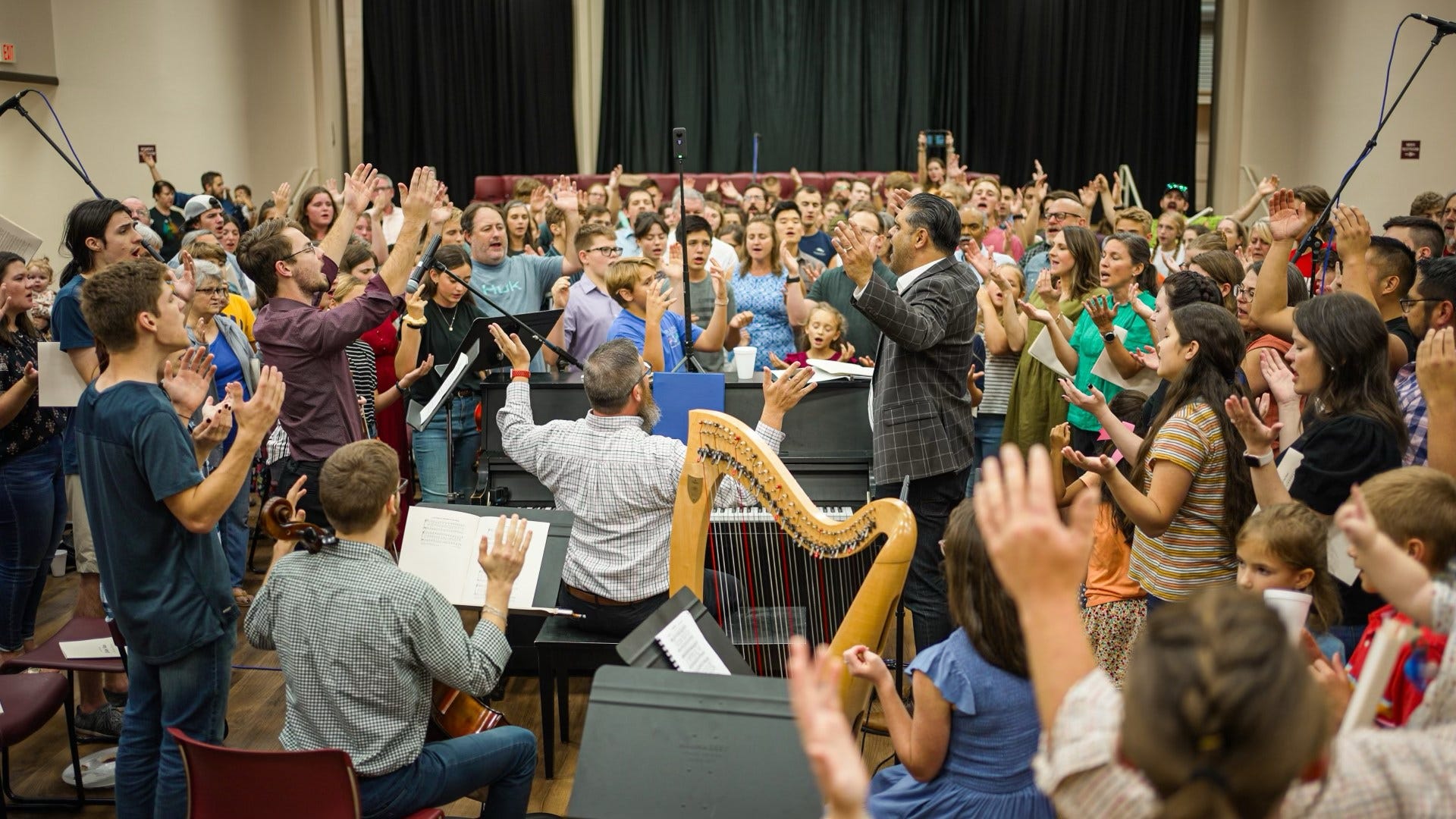
We believe Christ is reigning now, and that fact changes the way we preach, teach, build, educate, and raise our children. We do not treat the Great Commission as an impossible dream. We don’t spiritualize it. We do not look at history as though Jesus were waiting to become King. He is King, and the nations belong to Him.
That confidence is not triumphalism. It is obedience with a future. It is the reason we can labor without panic, build without apology, and teach our children to sing Psalms as heirs rather than refugees.
Our Scriptural Starting Point
But connected to that eschatological vision are our starting presuppositions. The CREC asserts that we are not ashamed of the Word of God or its language. The language of the Scriptures is the vocabulary of heaven, and we submit to its wisdom in totality. It further gives us confidence in affirming doctrines like six-day creationism, though many consider us fundamentalists. It is nearly impossible to enter the CREC while denying the Genesis paradigm.
By affirming our commitment to biblical revelation, we are not belittling tradition but restoring tradition to its rightful place. The testimony of the church and tradition leads us to a high and reverent esteem for the Sacred Scriptures. In light of that, we find trajectories towards Rome or Eastern Orthodoxy to be more than dogmatic errors, but soul-errors that may, and have, damaged our Christian legacy and our Christian vision. The CREC is commitedly Protestant.
We do not begin with neutrality. We do not ask an autonomous man to approve the first sentence of Genesis before we believe it. We receive the Scriptures as the Word of the living God and then order our thinking, worship, homes, schools, and public witness accordingly.
Our Covenantal Table
Finally, our paedocommunion practice is fundamental to our existence as a whole. While this is the practice of the CREC everywhere, or at least 99% of our churches, it’s crucial to note that without the communing of baptized children, the CREC would fail to offer the grounds for our covenantal theology. Covenant communion is the way we enflesh our theology of children.
We affirm that baptized children shall receive all the covenant benefits. We also believe that they are integral members of the body of Christ, without whom worship would be incomplete. While some congregations can function outside this system, they must understand that they are co-laboring with an undeniable majority who believe life and table, water and word, bread and wine, worship, and participation belong unto them.
This is not a small liturgical preference. It is tied to how we view the covenant, the church, worship, children, and the promises of God. Our children are not spectators of the faith. They are not tolerated in the assembly until they become useful. They are members of Christ’s body, and the Table is part of their inheritance.
We are happy to form fraternal relations with many denominations, and we have a growing sense of unity with a host of institutions and denominations that share our conservative political convictions against the insanity of the leftist ideologues. The goal is to build much more on those in the months and years ahead.
But fraternity does not mean confusion. We can labor alongside brothers in other communions without pretending we are the same institution. We should be grateful for shared causes, but we should not be embarrassed by our own commitments.
While we wish to continue growing, we understand that not every church is a good fit for the CREC. While we cherish the hundreds of inquiries we receive worldwide and the overwhelming interest in our communion, we also want to grow in a manner that honors who we are without diluting the principles that have made us who we are.
Growth is good, but growth without clarity is not health. We do not want to become a generic conservative Reformed landing place. We want churches that understand our grammar: postmillennial, presuppositional, covenantal, liturgical, catholic, and cheerful under the reign of Christ.
In short, we are Contra mundum, pro Christo, which is not merely a motto. It is a way of seeing the world, loving the church, raising our children, and laboring for the kingdom. This is who we are. This is the CREC!
Notations
At Eden, the way to the tree was closed by sin. At Calvary, the way was opened by blood. In the Supper, the church begins to taste that life now. In the New Jerusalem, she eats of it forever.
Adam fell because he reached for the gift before the gift was his. He sought to coronate himself before the Lord of heaven crowned him.
The growing interest in Africa and South America for the CREC is a testament to the fact that good liturgy is translatable and adaptable.
Thank you for this, pastor Uri, and for your 3 years of service to the CREC churches. This excellent summary has much value.
I trust you're going to remain a strong and helpful voice in your writing.
Thank you, brother. Been doing a lot of thinking and praying about what our distictives are and how the "movement" gains generational staying power. What we are has to be strongly communicated, arguably more so than what we are not. Very helpful thoughts. My oldest two children are at Summer Sanctus with you as we speak. Praying for your efforts!