Isaiah is the prophet the Church cannot ignore. His voice rises in every season: Advent, Christmas, Epiphany, Lent, Easter. Isaiah is large. He stretches across history; he speaks with the thunder of heaven; he unveils Jesus before our very eyes. And at the center of his prophecy sits that old, sturdy word: hope. Hope is the Christian’s armor. Hope is the drumbeat under our feet. Hope is the refusal to let darkness dictate the last word. Take away hope, and you take away the Christian’s song.
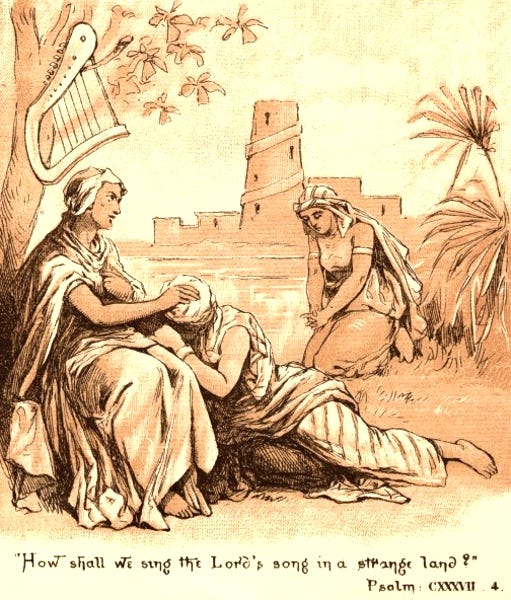
But here is the question the prophet raises: what do we do in the space between hope and fulfillment? Between longing and arrival? Between Advent and Christmas? God’s people have always wrestled with that tension. Isaiah preached into a world collapsing around him. The northern kingdom was already dragged into exile; Judah was tangled in idolatry; Assyria pressed in like a hungry beast; Babylon lurked behind, waiting its turn. Misery sat on top of misery. Their songs sounded like Psalm 137,
By the rivers of Babylon, there we sat down and wept
when we remembered Zion.
We hung our harps
upon the willows.
For there our captors made us sing
and our tormentors made us entertain,
saying, “Sing us one of the songs of Zion.”
Into that kind of world, Isaiah steps and speaks hope. He sketches a future so grand only faith could take hold of it. He speaks of nations streaming uphill to the mountain of God, of ordinary people calling to one another, “Come, let us go up to the house of the Lord.” Isaiah says that in the last days — the days inaugurated by Jesus Himself — the people of God will be anchored, established, unshakable, drawing the world with a child’s eagerness.
Yet Israel missed it. They waited for a salvation of their own design. They said “no thanks” to the prophets, “no thanks” to repentance, “no thanks” to hope. Isaiah comes with a word of life, and they choose death instead.
So Isaiah 2 presses the question on us. What do we do between the promise and its fulfillment? What do we do when we say, “I long for Jesus,” but our lives feel fragile, distracted, sorrowful, or numb?
This is where Isaiah surprises us with his answer: we practice together.
On this mountain, the Lord of hosts will make for all peoples a feast of rich food…
Sing to the LORD, for He has done glorious things.
We gather. We lean on one another. We rehearse the joy that is coming. Advent is practice for Christmas. It is the warm-up before the feast. It is the choir clearing its throat. It is the family gathering kindling before the fire is lit. Isaiah invites us to say to one another: “Come, let us go up to the mountain of the Lord.” Not, “Go by yourself,” but, “Come with me; I will walk with you; I will bring you a meal; I will sit with you until hope finds its way back into your bones.”

Hope, in Scripture, is never a solo performance. Hope is a choir.
When someone says, “But you do not know my sadness, my sickness, my struggle,” we answer with Isaiah’s call:
Come. Come with us. Come and walk in His paths.
And so, beloved, enter this season with expectation. Christ has come, and Christ is coming, and in the meantime, we practice hope together. We do not stare at the life of the Church as if she were a museum exhibit. We come inside. We take our place at the table. We sing. We feast. We practice and pray and laugh and live together in the place of God’s dwelling. Advent trains our hearts to hunger for that sounding Christmas joy.
Advent is practice for Christmas. Come. Let us play, let us hope, and let us ready our voices, for the joy of the world is drawing near.
I will be headed to San Francisco/Sacramento this week for my annual 3-day trip. I am grateful to serve in my sixth year as Senior Fellow of Pastoral Theology. Dr. Sandlin has been a jovial friend and a delightful host over these many years. So, I will be gathering with some old friends, and then ministering to our CREC congregation led by Pastor Paul Liberatti in Sacramento: