Awaiting the Lord Who Comes
We are now halfway through the Advent Season, and our hope is rising as the Messiah nears us in the biblical story. Advent means “coming,” and during this season we proclaim that Christ has come at His Incarnation, born of the Virgin Mary; that He comes to us even now, comforting, guiding, and renewing His people; and that He will come again in glory to judge the living and the dead. Advent carries a past, present, and future: Christ has come, Christ is coming, and Christ will come again.
If we carry the theme of Advent throughout the Bible, we are not limited to Old Testament instructions but to other rich portions as well. We find such an Advent text in Paul’s writing to the Thessalonians.
1 Thessalonians 5 is the closing portion of Paul’s letter to a faithful congregation. Unlike Corinth, the Thessalonian church received Paul’s praise. Their faith had “gone forth everywhere,” and they had turned from idols to serve the living God. Yet even this joyful church carried sorrows, most pointedly the grief of losing loved ones. Paul answers their fears as the resurrection prophet, urging them not to grieve as pagans do, for Christ’s coming would bring comfort, clarity, and light.
Paul speaks of many comings of the Lord. God comes again and again to judge, to heal, to deliver, to reshape history. He does not watch the world distantly. The world is His story, and He enters it as He wills. Yet two comings stand above the rest: the first in Bethlehem and the last at the end of history. In between lies a coming that shook the world of the first century.
The Coming That Reshaped a World
Paul, Thessalonica, and the Near Horizon of Judgment
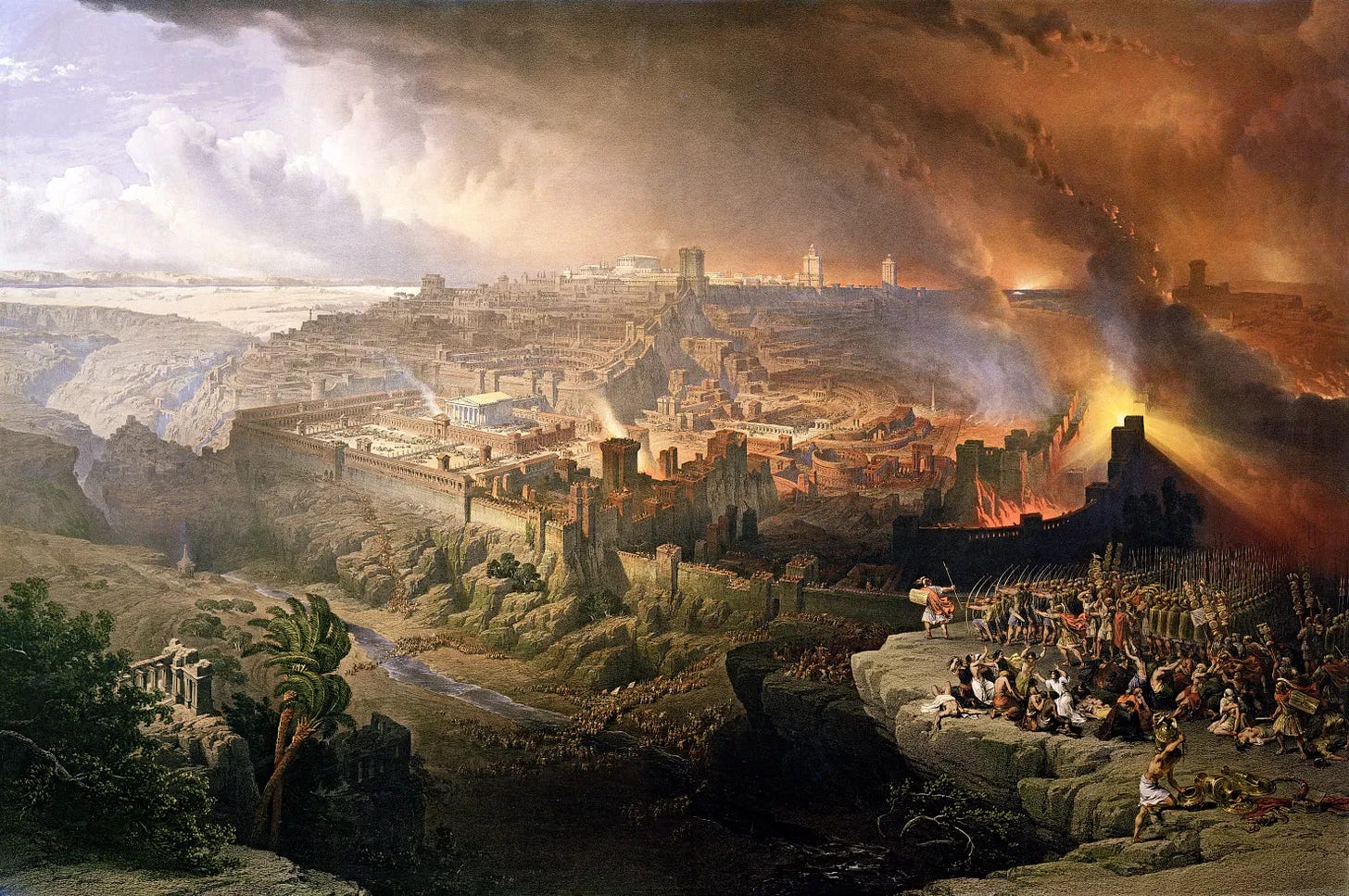
Jesus told His disciples that a great judgment would come upon their generation, a day when Jerusalem, the temple, and the Old Covenant order would fall. This was not addressed to modern America; it was spoken directly to a first-century audience. And in AD 70, Christ came in judgment, ending the temple age and vindicating His prophets and apostles.
Paul writes in the 50s, barely twenty years before this cataclysm. His pastoral aim is to prepare the Thessalonians for this “Day of the Lord,” a day that would come like a thief to unbelievers yet not surprise the vigilant Christian. The church was to live faithfully in the shadow of both this near judgment and the final coming of Jesus at the end of history. Paul’s words, therefore, speak both to his original audience and to the church of all ages, for we too face death, discouragement, persecution, and the need to remain sober and alert.
With this larger horizon before them, Paul turns in 5:12 to the shape of Christian life in a world where Christ comes—in judgment, in mercy, and at the end of all things. If we hope in the Coming of the Lord, then we cannot hide our souls. Our Christian testimony must be externalized in community, character, and love.
Living Ready for the Lord
Honor, Peace, and the Shape of Christian Community
Paul begins with a simple but earnest plea: “We ask you, brothers…” He implores the Thessalonians to honor those who labor among them, especially those who admonish and guide the flock. Peace in the church requires respect for its leaders and harmony within the community. The ancient world prized local community, and Paul insists that local peace matters deeply. We cannot claim to love the global church while dishonoring those God has placed over us or ignoring the neighbor beside us.
This exhortation carried particular force in Thessalonica. Some leaders had been former synagogue officials or Gentile community figures who, upon converting, now shepherded a diverse congregation of Jews and Gentiles. Old enemies were becoming brothers. Former opponents were now fellow worshipers. Paul urges the church to esteem these laborers “very highly in love,” not because of charisma but because of faithful work.

Reformed missionary Wes Baker’s story captures this spirit. When he arrived in Peru, he went door-to-door introducing himself simply as the neighborhood’s new pastor. The people welcomed him as a man sent to care for their souls. Paul desires that kind of honor, affection, and peace for the whole church.
And what is the fruit of such honor and affection? Paul gives it plainly: “Be at peace among yourselves.” Pride destroys peace; the gospel restores it. Matthew Henry once wrote that God’s people should do “all they can to hinder differences from rising or continuing among them.” There is no texting our way out of conflict, no hiatus from reconciliation, no option to withdraw from the body. Advent itself is the season when Christ comes to reconcile humanity and to bring peace to His Church.
In this season of holy anticipation, we taste the peace He brings. Christ comes to us in our weakness, in our sorrow, and in our longing, meeting us with mercy as the Light who breaks into our darkness. And as we draw near to the celebration of His Nativity, He prepares us to stand blameless and joyful at His appearing, whenever He comes.
Providence Church now has its own media page: