

When Strongholds Fall: An Advent Tale of God’s Unconventional Arrivals
The unconventional advents are always the most astounding. They slip past expectation and overturn our assumptions. One of the most humorous biblical stories captures this dynamic in vivid detail. It begins in 1 Samuel, in a moment when Israel felt secure and certain that God was near.
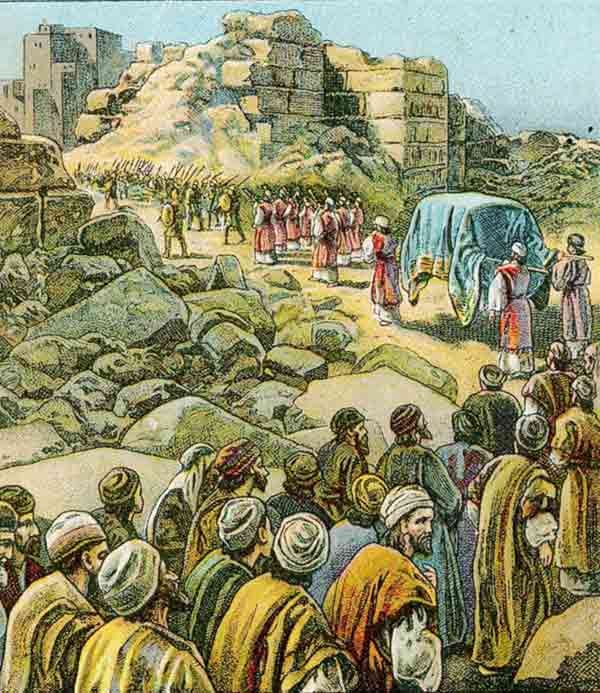
Israel was encamped at Ebenezer—“stone of help”—the very image of stability and assurance. From this place of confidence, Israel marched forth to meet the Philistines at Aphek. But the unexpected happened: four thousand Israelites died, and the army was defeated. This was not the advent they had in mind.

Stunned, Israel asked the question we often ask: Why would God allow this? Their solution was quick and dangerous. “If we bring the ark of Yahweh from Shiloh to Ebenezer, indeed God will be with us.” In other words: Bring God to us. Advent Him. Make Him arrive by force so He can give us victory. If they could get the ark into camp, they believed they could drag God’s presence with it.
But the priests overseeing the ark were Hophni and Phinehas, two men whose corruption was notorious. These men had no business handling the holiest object in Israel’s life. When people attempt to control God’s presence and place false shepherds in charge of holy things, disaster is never far behind.
And so it comes swiftly. The Philistines realize Israel’s spiritual maneuvering is hollow. 30,000 more soldiers die. Hophni and Phinehas perish. When the news reaches old Eli—that his sons are dead and the ark taken—he falls backward, breaks his neck, and dies. The story falls to its lowest point.
But it is precisely then that divine humor awakens.
When God Advents Himself in Enemy Territory
The Philistines parade the ark from Ebenezer (“stone of help”) down to Ashdod, a name meaning “stronghold.” They carry it further still into the temple of Dagon. And here the narrator invites us into a tongue-in-cheek geography: the “Stone of Help” has been taken into the “Stronghold,” into the house of a god whose very name in Aramaic means “to cut open.”
The Philistines intend to humiliate Israel’s God. Their message is clear: “Let this God bow before our god. Let Him be the one cut open.”
But God has other plans.
Morning comes, and Scripture says:
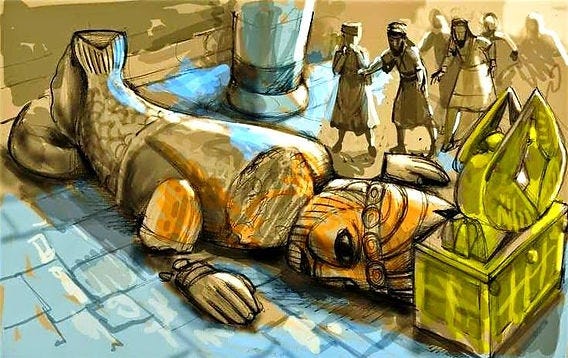
“Dagon had fallen face downward on the ground before the ark of the LORD.”
The priests of Dagon scramble to lift their broken deity back into place—always the sign that your god is not much of a god at all.
The next morning, the scene escalates:
“Dagon had fallen… and the head of Dagon and both his hands were lying cut off on the threshold.”
The god whose name means “to cut open” now lies cut open. In the heart of Ashdod’s stronghold, Yahweh Advents Himself; not by being dragged, not by being manipulated, but by coming in quiet, majestic power. And His coming topples idols without lifting a sword.
The story now asks us: Do you see how God arrives where He wills, not where we try to place Him?
Do you see how His advent confounds the strongholds of this world?
When Our Attempts to Force God Backfire
This tale is humorous because it mirrors our own tendencies. Israel tried to Advent God by force, and we often do the same. We do it when we assume God must act according to our timetable. We do it when we treat faith like a spiritual vending machine, imagining that certain words or rituals can summon God into our battles. We do it when we approach Jesus as a good-luck charm—a Hallmark-card deity who exists to affirm us and shield us from discomfort.
But God will not be handled.
He will not be summoned.
He will not be dragged into our camp for our convenience. God’s advent is not something we manufacture; it is something we receive.
When Jesus Advents to Us in Our Waiting

Advent is the season that slows us down enough to notice this truth. The Gospels show us that Jesus comes to us not when we demand, but when we wait upon the Lord. He comes…
when Philistines are at the gate,
when careers crumble,
when a loved one suffers,
when our children falter,
when we falter,
when Christmas has not yet arrived and our hearts ache for it.
In those moments—moments saturated with longing—He Advents to us in His glorious presence. Not by force. Not by manipulation. But by grace.
And Dagon’s comic collapse becomes a pastoral lesson:
Wait for the Lord; do not try to manipulate His coming.
When we wait, His timing makes a mockery of the world’s strongholds.
When we wait, His arrival topples every false god we have leaned on.
When we wait, He shows Himself to be our true Ebenezer, our Stone of Help.
His advent always arrives at the right time.
It always topples the right idol.
And it always secures His people more than any strategy of ours ever could.
Nuntium
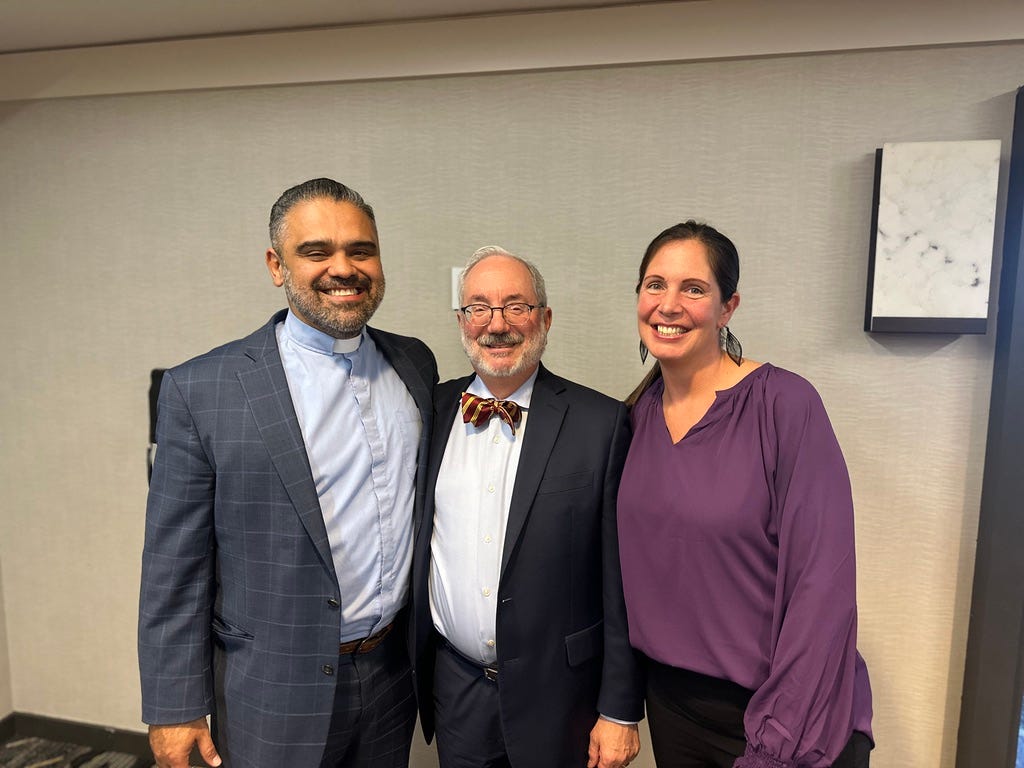
Last Saturday, I joined the CCL community to celebrate its twenty-fifth anniversary. Each speaker offered sobering and substantive insights across a range of disciplines. The recurring theme was a call to cultivate a distinctly Christian culture in place of the many modern fabrications that currently pass for coherence, some of which have arisen from within the Christian ecosystem itself.
This year’s format leaned more intentionally toward a conference model, which allowed Dr. Sandlin to welcome a broader audience. The lectures were marked by careful scholarship and accessible theological paradigms. I was especially grateful for the thoughtful use of rhetoric. The older I get, the more I value material that is carefully articulated and communicated with intention. Good language knows where it is going and refuses to be cluttered with the filler so common in modern discourse.
It was a particular delight to hear Jerry Bowyer in person, having previously encountered him only through Zoom conversations with Theopolis. He proved to be a strong and thoughtful addition to the gathering, offering Jordanian insights into economic theory. His analysis of Genesis 1 was a highlight for many in attendance.
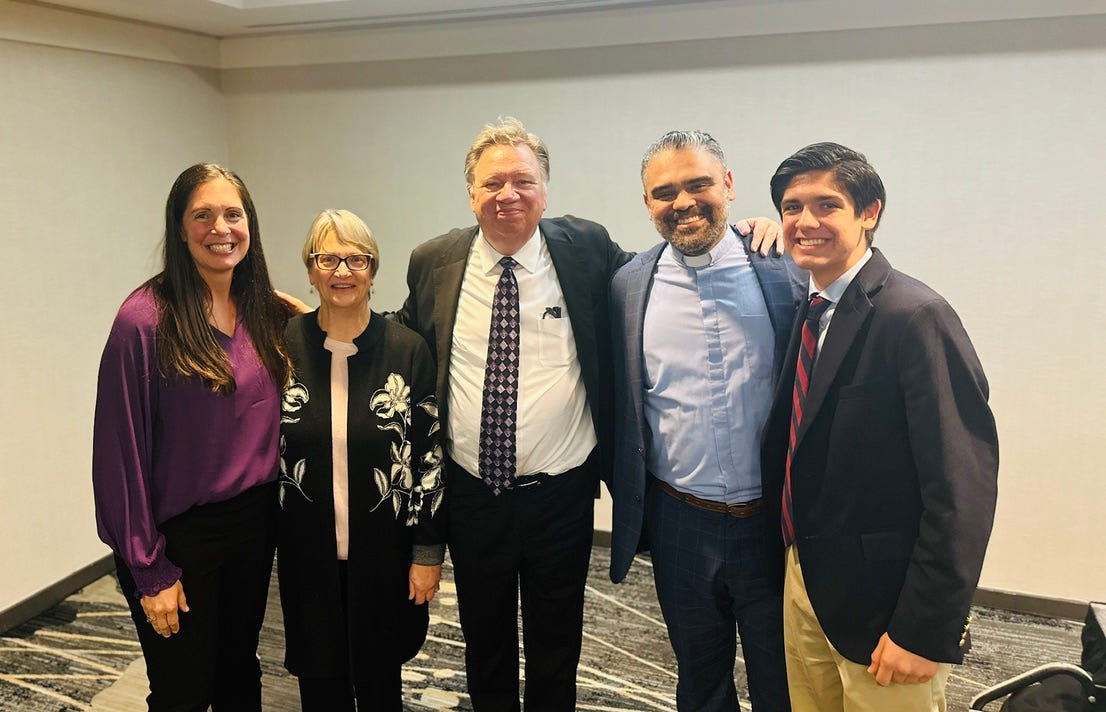
The ever-productive David Bahnsen once again shone with his characteristic wit and insight. I continue to treasure David’s presence in my life and his contribution to contemporary economic discourse at the national level. And as always, a double gratitude to the brilliant Jeff Ventrella, who has become a dear friend.
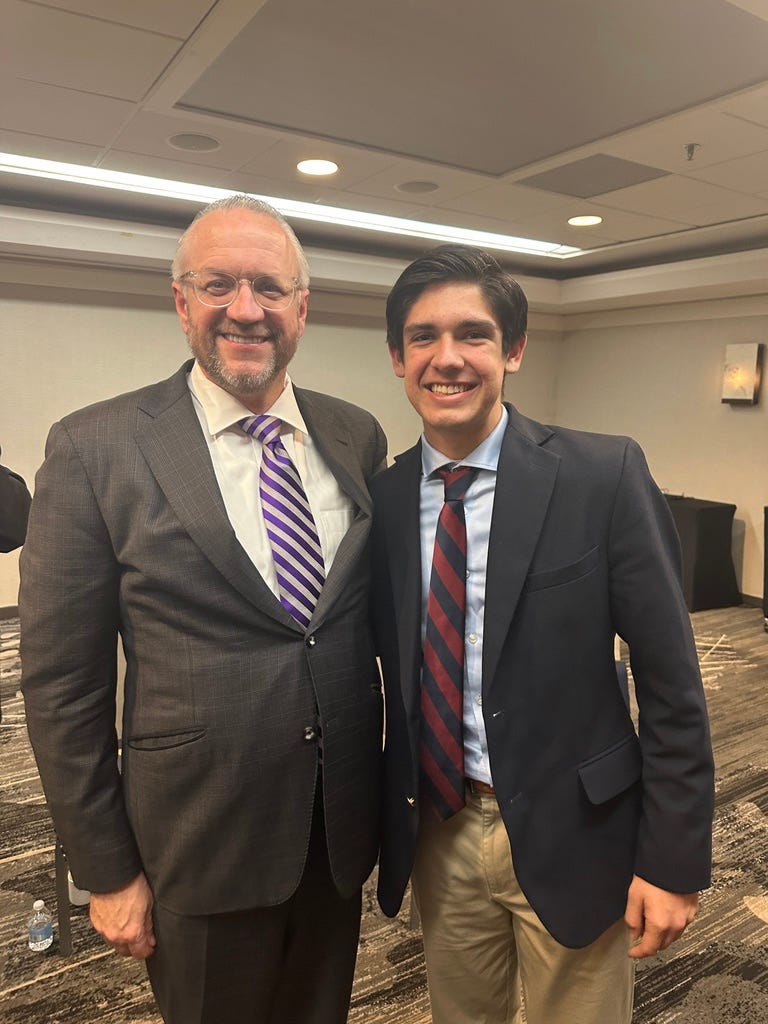
Finally, I am deeply grateful to Andrew Sandlin for this conference and for his tireless labor in bringing serious scholarship and biblical rationality into sustained conversation with our broader culture—the kind of work that quietly forms minds, steadies institutions, and shapes Christian imagination for the long haul.