

The CREC Council approved the first reading of a New Westminster Confession at the last Council in Nashville, where I presided as PMOC. Some are apoplectic over this, but Pastor Ben Zornes puts things into perspective.
A few things. The preface of this work describes what we are attempting. We are happy for it to take time, and we are more than happy to welcome charitable and honest feedback.
But to those objecting to a new WCF, there is already precedent for that in the LBC, Savoy, and WCF 1788.
The CREC is not uniform in the confessional standards which each church holds to, but we allow a Reformed ecumenicalism. Which is why there are several different Reformed confessions which an individual church can hold to. This New WCF would be a "get to not got to."
The question will be whether the CREC wants to incorporate it (after much prayer, deliberation, study, and editorial input) into the list of approved confessions. What took place at council last month was simply approving beginning that process. It hasn't, as yet, been adopted. What has happened is that we said, "Let's begin the process."
But the fundamental concern is that The New Westminster has added language that favors paedocommunion:

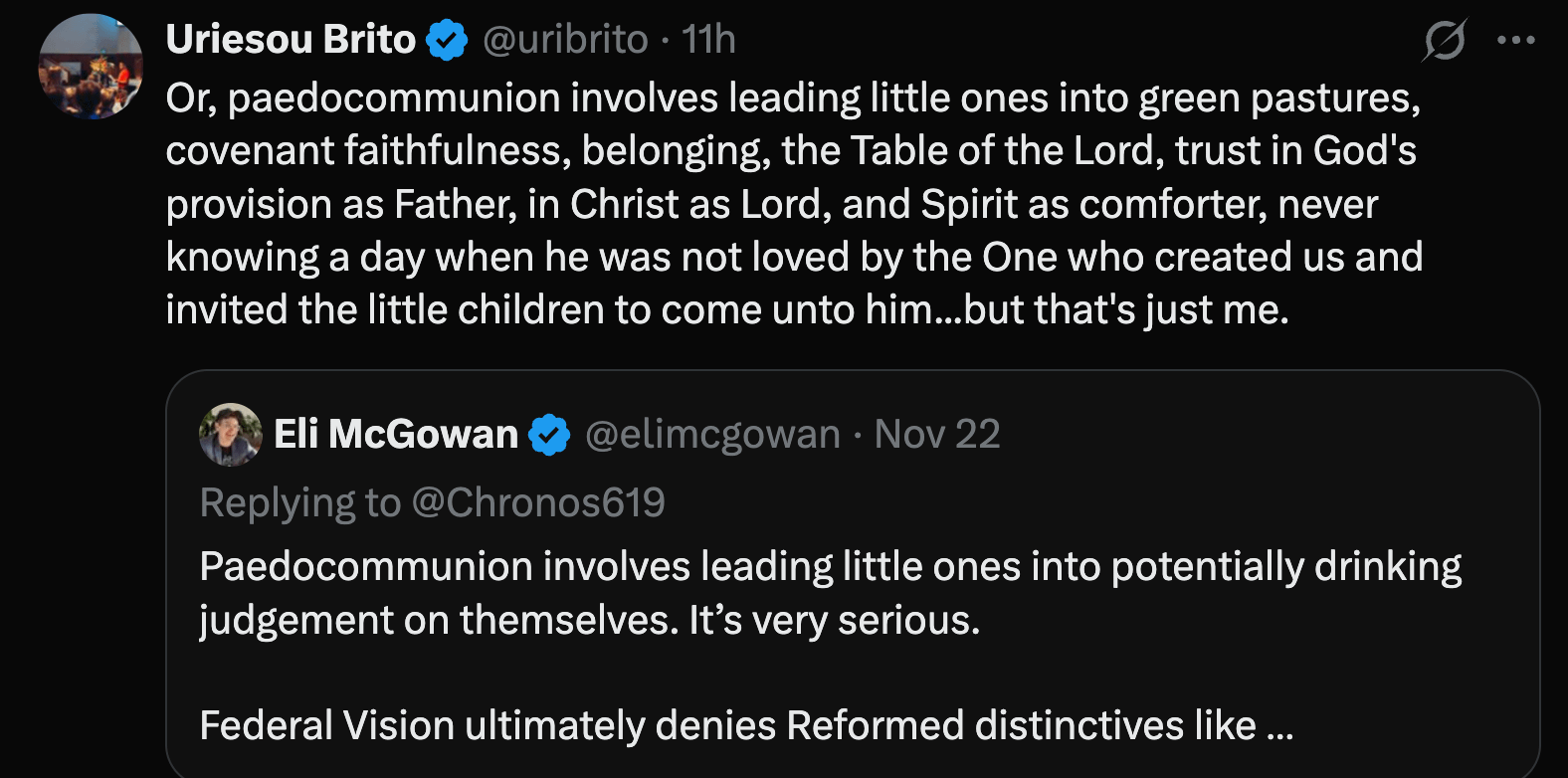
In light of some concerns over the doctrine of paedocommunion, a doctrine and practice which has been prevalent in the CREC for over two decades and which is receiving some renewed attention due to ambulance chasers online, I’d like to walk through a family fight in a 1st-century town called Corinth. The Apostle Paul dedicates significant space to this event because it exemplifies the kind of behavior that deteriorates a body. It signifies an undoing of the ecclesial function, and Paul condemns it with strong words.
The Corinthian Table
When people come together, there is a happy assumption of unity. Sure, misunderstandings take place. Morning routines can be a bit chaotic in the home with little kids. But a prerequisite for a meal is a united sense of direction and respect. As Proverbs states, Better a dinner of herbs where love is than a feast with hatred. So, you put aside disagreements about the extent of Biden’s cognitive abilities and come together as a family.
This was not happening at the tables in Corinth. Some of the Corinthians with greater resources are feasting on their own food and wine, while the poorer Christians “who have nothing” are going hungry.[1] They are despising a part of the body at a meal that should express our oneness.
The Architecture of Corinthian Homes
In Corinth, the Supper did not happen in a public place but in a private home. This home was most likely owned by someone with a higher social status; perhaps he was converted from a prestigious political office.
In a Corinthian home, which we know from archaeological discoveries, the house was divided into a dining room (triclinium), which could accommodate around nine people, and the atrium, which would be a bigger area and accommodate another 30 people. Remember, the early churches were small. There were no megachurches in the first century. The church was being established and growing in homes.
Paul wanted order and decency in these small gatherings. Yet, the host of the gathering, one of the wealthier members of the community, kept his highly influential friends in the dining room, and the members with lesser means stayed in the atrium. It would be quite common for those in the dining room to receive better wine and service than others. It’s very much like a first-class flight where you get extra legroom, drinks, and food, and everyone else gets stale pretzels.

Pliny the Younger describes this in one of his letters when he writes: “The best dishes were set in front of himself (host) and a select few, and cheap scraps of food before the rest of the company.”[2] Paul says in I Corinthians 11, verse 22, that this is not just bad manners; it’s a humiliation of those who have nothing. They are despising this communion by eating their own private food without sharing.
Despising the Unity of the Body
I remember going into the slums with my father as a kid to do evangelism. The stench was just overwhelming. But when he walked into little shacks (called favelas), they always brought out the best cakes and coffee. This was someone outside their community, so they would offer the best. And we all shared the same food and drink together. They reserved the best for the community.
But in Corinth, there is no corporate partaking of the same food and drink. Remember that in the early church, the entire meal was served with the wine and the bread. It was all bound up in one meal. Paul is furious with the way they are dividing the church. They are putting up walls when the death of Jesus comes to break down barriers. He concludes in verse 22: “I cannot commend you.”
So, Paul goes over the a,b,c’s of the meal our Lord instituted. He uses intentional language in verse 24: “Do this in remembrance of me.” We look at such a phrase and read it as a call to look within, close our eyes, and meditate. Many interpret such a phrase as an act of nostalgia. But Paul is not telling the Corinthians in the middle of table wars, “Every head bowed and eye closed.” No, the idea of “remembrance,” better translated as “memorial,” is to collectively reassert the past, present, and future of our history. When the Bible says, “Do this unto my memorial,” he is praising God for what he has done in the past, in the present, and in the future through Jesus Christ. Paul says, “Come to the table to see what God is doing through this family meal.” This is not a command to meditate; it’s a command to know God’s promises in Jesus Christ.

But the Corinthians live as if he didn’t come, as if he didn’t set redemptive history on a forward trajectory, as if he didn’t break down barriers, and as if they are still under cultural bondage as slaves. No. The Supper unifies the past, present, and future, and you better get with the program lest you fail to discern this body, the Church. This corporate amnesia is what Paul means when he warns them not to come to the table “in an unworthy manner.” The Corinthians are not memorializing God’s works; therefore, they cannot see that Christ has destroyed barriers at the table. They are unworthy because they cannot see one another as participants in God’s unifying act at the cross and tomb.
Paul is not concerned with intellectual competence or the capacity for self-conscious introspection.[3] In fact, I’d argue that if being worthy means being self-aware of the intricacies of theology—as some argue—it would create even further division. “Well, here is the elite who read four books a week, and here is the other who read four books a year.”

In other words, what does God expect from his people before they come to the Supper? What kind of proof must we show that we don’t want to fight in a family meal? The answer is simple: The proof that a Christian—young or old—must display is his desire for unity in the body of Christ, not his performance of self-introspection. Paul argues that a person proves himself by table fellowship, not by how thoroughly he or she understands or digs into his/her heart. The Corinthians are doing the Supper in a way that visibly divides and causes schisms and division in the church.
The rules of the church are different. When we gather, we eat and drink together: the wine and the bread are ours just as much as they are for the richest or the most famous in the church. Paul’s argument is against those who consciously try to divide by status, race, money, power, or anything. Those are Paul’s imprecatory targets. Anyone who diminishes the status of another is in sin. Those are the ones Paul threatens.
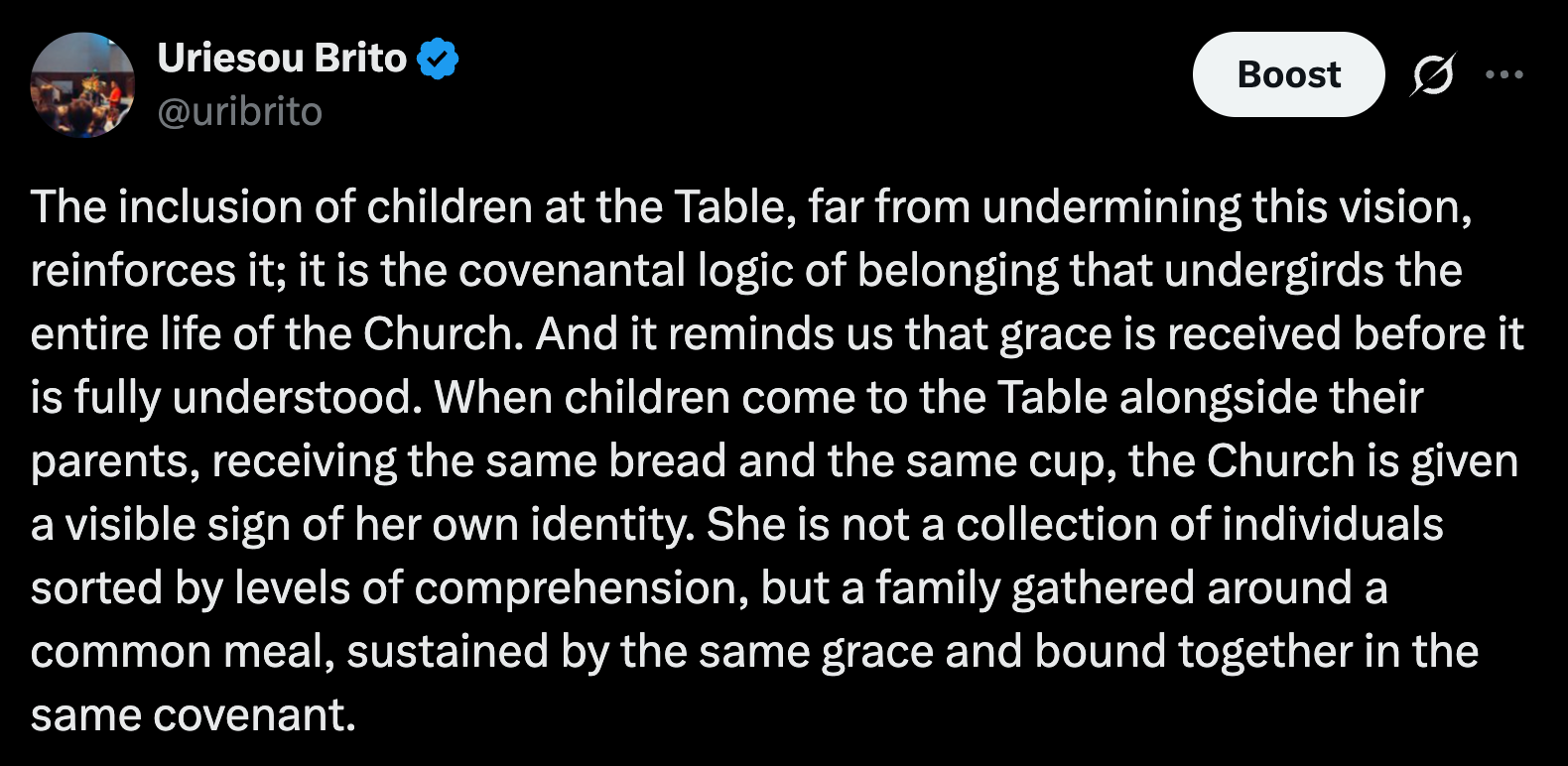
The unity of the Church is the heart of the family table and of all other meals we enjoy together. In Christ, we eat and drink salvation for ourselves and others. The family table is restored when we affirm that Christ united the entire church—composed of young and old— into one great banquet.
[1] Richard Hays, Richard B. Hays, First Corinthians, Interpretation: A Bible Commentary for Teaching and Preaching (Louisville: John Knox Press, 1997), 199–200.
[2] Hays, 198.
[3] Jeffrey J. Meyers, The Lord’s Service: The Grace of Covenant Renewal Worship (Moscow, ID: Canon Press, 2003), 368.