

Is there a case for anointing with oil that applies to the first-century church? Should we view oil as medicinal? Was James addressing oil merely as symbolic of healing? Or should we take it literally? Further, is this related to the Roman Catholic doctrine of extreme unction applied to people as they near death? Is it sacramental? In this essay, I want to make a brief case for a Church practice of anointing with oil that avoids sacerdotal trajectories and commemorates God's mercy in healing.
The text is quite direct in principle, and the methodology used for the practice:
13 Is anyone among you in trouble? Let them pray. Is anyone happy? Let them sing songs of praise. 14 Is anyone among you sick? Let them call the elders of the church to pray over them and anoint them with oil in the name of the Lord. 15 And the prayer offered in faith will make the sick person well; the Lord will raise them up. If they have sinned, they will be forgiven. 16 Therefore confess your sins to each other and pray for each other so that you may be healed. The prayer of a righteous person is powerful and effective.
Jeff Meyers argues in his persuasive commentary on James that the command applies to those suffering persecution and, thus, enduring great tribulations, both physically and spiritually. If so, the anointing practice applies beyond deathbed experiences to a wider range of needs. It is not a sacrament. Sacraments are means experienced by the entire congregation. This is one reason Luther rejected the sacrament of marriage and ordination.
Perhaps we may use the language of sacramental, but not of a sacrament. According to St. James, the parishioner requests the liturgical practice of anointing rather than the pastor initiating it for all people. It has a particular function within the body, as it did among those suffering persecution in the first century.
When considering anointing, we should remind ourselves that such practices are always rooted in Old Testament initiation rituals.1 Healings in the Bible invariably have a symbolic and typological meaning. Direct healings were common during periods of redemptive history when special revelation was given directly to God’s ambassadors. Because it is typological, it does not eliminate or remove the need for physical means. Rather, it signifies that it may have a different redemptive purpose in the New Testament.

And it follows that we cannot say to every afflicted Christian, “Jesus will heal you now through the use of oil.” We are not orphans of revelation. The completed Word and the completed Christ have been revealed to us. There may be many reasons why Jesus does not want a particular person well at a particular time. God’s ways supersede our desires, even those rooted in the good desire to be well again.
In the resurrection, God has judicially declared the world cleansed of evil; that is, God has re-symbolized the world from darkness to light. And since the Pentecost of Acts, the church is the society of the saved; the institution chosen to bring healing to the nations. A ministry of physical healing is an integral part of the work of the church.
To Heal or Not to Heal?
In cultic rituals, Satan has the power to grant temporary physical healing, and those who seek health for reasons of personal greed and pleasure may thus find their latter state worse than their former. To endorse evil so that good may come only leads to the corruption of body and soul.
The Biblical method is uncompromising. It is rooted in the purpose of God to restore his chosen people to wholeness again. The practice is for the church elders to pray over an individual, asking if the man/woman has any sins to confess. The confession declares that God is invested in cleansing the whole person. The minister may ask whether the anointed has sins to confess. Such situations can lead to fruitful discussions even before the anointing takes place. It can give ministers an opportunity to instruct the individual(s) and declare absolution in the name of Jesus Christ.
Since it is not a sacrament, the Reformed tradition rejects sacerdotal interpretations used in medieval and much of modern Roman Catholic liturgy. As is common in Calvin, he attributes whatever benefit the oil may have to the power of the Spirit. Therefore, there is no need to “consecrate” such oil, and what kind of oil is used does not matter (Olive Oil and Baby Oil are two we can recommend). The use of oil is not medicinal, contrary to the assertions among evangelicals who fear that mysticism may be creeping into the church. While such abuses can take place, there is a solid Reformational history of anointing the sick that does not fall into mystical rituals.
The anointing with oil is a ceremony performed “in the name of the Lord” by the elders. It does not conflict with or take the place of the labor of physicians. Rather, the church’s healing ministry forms the (symbolic) foundation and (whole-life Christian) context for medicinal help.
It is important to understand that only the gospel gives men health. The labor of physicians is important, but only as a means of holding back the curse. Physicians cannot give men true health. Nor can fasting, exercise, dietary laws, or any other feature of the Old Creation. The first creation is decaying. It is only the New Creation that can bring true health through transfiguration. It is only in Christ and in eating His Spiritual food that healing can take place.
What does it communicate?
Anointing with oil is a sign to the sick, spiritually grieving, or dying person, enabling him to turn his suffering into true martyrdom; to be a true witness to the transforming health the gospel gives in the post-resurrection world.
All Christians are martyrs (witnesses) in the general sense, but the suffering Christian is a martyr (witness) in a special, exceptional sense. God is most specific through James. If we need healing, we are to approach our local church’s elders (plural) with a confession of sin and ask to be anointed with oil.
We may further ask, “If God rejects our request for healing the first time, should we return and try again down the road?” Should we call upon the leaders of the Church a second time? Paul states that he came to the Lord three times (2 Cor. 12:8; and cf. Luke 18:1-7 on perseverance in prayer). Paul did not make a fourth request. This provides a rule for us.
If God does not grant healing the first time, we should return with renewed petition two more times. If, after three requests, God still does not grant health, then we are to understand that He has a special purpose for us, rejoice in that exceptional calling, and view the rite of unction as a means of transforming our problem from a manifestation of the curse into a special manifestation of the Kingdom, for our good and the good of others.
The elements James sets forth are confession of sin, a request for healing, prayer for healing, and anointing with oil. James also indicates that several elders should be present, which again runs counter to the modern one-man-show approach of self-made healers. The plurality (2 or 3 witnesses) confirms that the Church works for the needy and sick, and God’s mercy will flow according to God’s rich healing power.
1 See my Samson post, where I speak about head theology and its unfolding symbolism.
Nuntium
I have been in Nashville for 11 days now, preparing for Council, but also lecturing, preaching, meeting, and writing. The long 12-14 hour days haven't slowed me down yet, though I suspect my body will need some adjustments when I return home this weekend. Council has officially begun, and it’s the culmination of three years of work. The labors of the Council team have been remarkable, and I hope we can get a picture together to memorialize this august occasion that has gathered over 800 people worldwide.
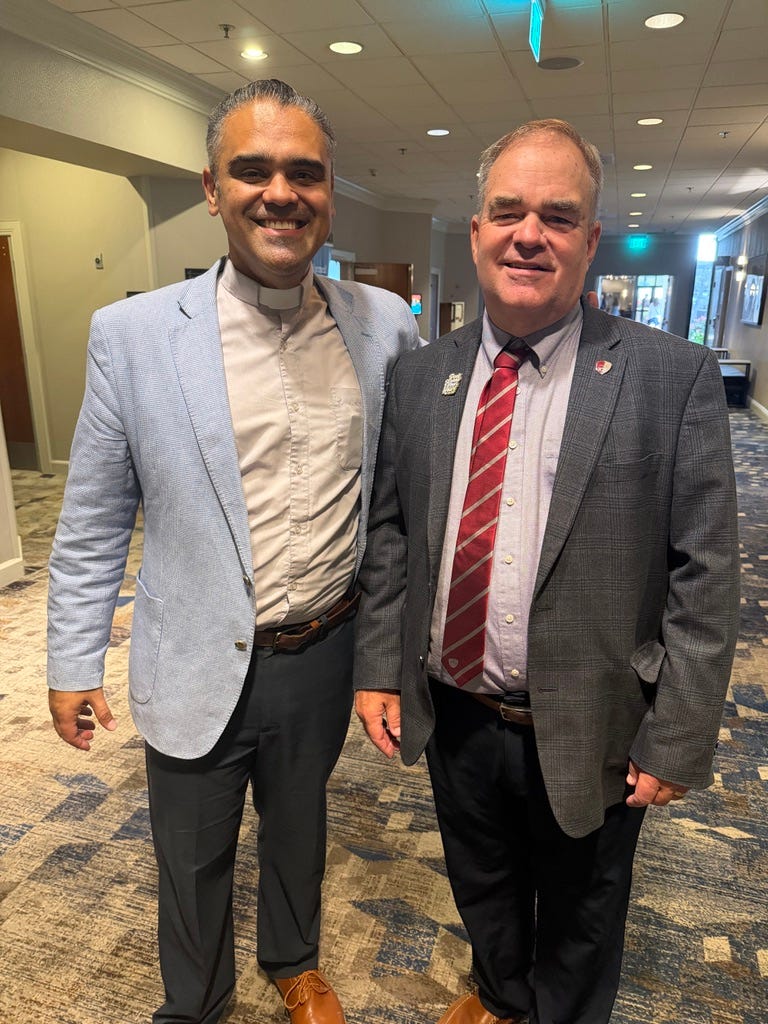
Our Pre-Council Counseling Conference went splendidly well here in Nashville yesterday. It was standing room only! Mike Ruff, Duane Garner, and Bo Cogbill hosted a needful gathering to discuss pastoral care for our CREC congregations. I gave a talk on the history of pastoral care, from Gregory the Great to Jay Adam and the second generation of biblical counselors, and concluded with ways for the denomination to move forward.
It was especially delightful to meet Dr. Jim Newheiser, a disciple of Jay Adam who has done a remarkable job moving the conversation with grace and courage and whose labors at RTS Charlotte have been a breath of fresh air in restoring biblical counseling to the forefront of that campus. I believe all these talks will be available through Reformed Evangelical Seminary in the days ahead.