Lent slows us down and compels us to face what we would rather avoid—suffering, weakness, and death. It presses upon us a question we cannot escape: What do we believe when the tomb is sealed? John 11 brings us into such a moment. Lazarus is dead, his sisters are grieving, and Jesus—who could have prevented it—has delayed.
This is not merely a story about Lazarus; it is a story about faith in the face of silence. What do we confess when God does not arrive on time? What kind of theology sustains us when death appears to have the final word?
The Mystery of Christ’s Delay
The story begins with love. Mary and Martha send word to Jesus: “Lord, the one whom you love is ill.” Their appeal is not based on merit or urgency, but on Christ’s affection. They trust His character. And yet, astonishingly, He waits.
Jesus does not rush to Bethany. He remains where He is for two more days. By the time He arrives, Lazarus has been dead for four days. The decay has begun; hope, it seems, has expired.
Why would Jesus delay?
This question echoes through our own lives. Why did the suffering come? Why was the prayer unanswered? Why did relief not arrive sooner?
But John will not allow us to conclude that Christ is indifferent. Jesus Himself declares, “This illness does not lead to death. It is for the glory of God.” What appears to be absence is, in fact, preparation. What feels like neglect is divine purpose.
Lent teaches us this difficult lesson: God’s timing is not our timing. Often, the moment that feels like abandonment is the very moment just before glory breaks forth.
Faith on the Road to Death
When Jesus finally determines to go to Judea, the disciples resist. They remind Him that danger awaits and that those who sought to stone Him are still there. To go to Bethany is to walk toward death.
But Jesus goes anyway.
And Thomas, often remembered for his doubts, speaks with striking courage: “Let us also go, that we may die with him.” In that moment, Thomas understands something essential about discipleship. To follow Christ is not to avoid death, but to walk through it. It is to embrace a life shaped by sacrifice and obedience.
The irony is profound: the disciples fear losing Jesus while standing beside the One who holds life itself. And yet, despite their fear, they follow.
So must we.
When Jesus arrives, Martha meets Him with words both honest and painful: “Lord, if you had been here, my brother would not have died.” This is not unbelief; it is faith under strain. She believes in Christ, yet wrestles with His delay.
And many of us know this prayer well. Lord, if You had acted sooner. Lord, if You had intervened. Lord, if You had answered differently.
But Martha does not end there: “But even now I know…” She clings to Christ even in confusion.
The Voice That Calls
Jesus responds, “Your brother will rise again.” Martha affirms the doctrine of resurrection on the last day. Her theology is sound, but Jesus presses deeper.
“I am the resurrection and the life.”
He does not merely promise resurrection; He embodies it. He does not simply give life; He is life. Resurrection is not only future; it stands before her in flesh and blood. Where Christ is present, life is already breaking into the world.
Then comes the question that echoes through every Lenten season: “Do you believe this?”
This is not merely intellectual. It is personal. Do you trust Christ when death surrounds you? Do you believe that life stands before you even when all evidence seems to deny it?
Martha answers with one of Scripture’s great confessions: “Yes, Lord; I believe.” She does not yet see the miracle. She does not yet understand everything. But she believes and that is enough.
Then, before the miracle, Jesus weeps.
The Lord of life stands before the tomb, and He weeps. He is not distant from our grief; He enters into it. These tears remind us that death is an enemy, not a friend. It is the result of sin, and Christ mourns its devastation.
But His tears are not defeat. They precede victory.
Soon, He will call Lazarus out of the grave. But we must not miss the cost: this miracle sets in motion His own death. In giving life to Lazarus, Jesus walks toward His own cross.
This is the pattern of the kingdom: life through death, glory through suffering, resurrection through the grave.
And this pattern shapes us.
Lent teaches us to wait when Christ delays, to trust when death seems final, and to believe when we cannot yet see. But Lent does not end in the tomb.
There is a voice that will speak.
The same voice that called Lazarus will one day call you. And when that voice speaks, death itself will obey. The Father will say, “Unbind him, and let him go,” and we will see with our own eyes what Martha confessed by faith:
That Christ is the resurrection and the life, and those who believe in Him will never truly die.
Notations
I used Bibleworks for over a decade for sermon preparation, but since its untimely death some years ago, I decided to make the transition to Logos, because, you know, it’s what the cool kids do. I have now surpassed 700 sermons on Sunday mornings at Providence, and I suppose I have gained a bit of sermonic stability. Here is an image of my prep work on Logos.
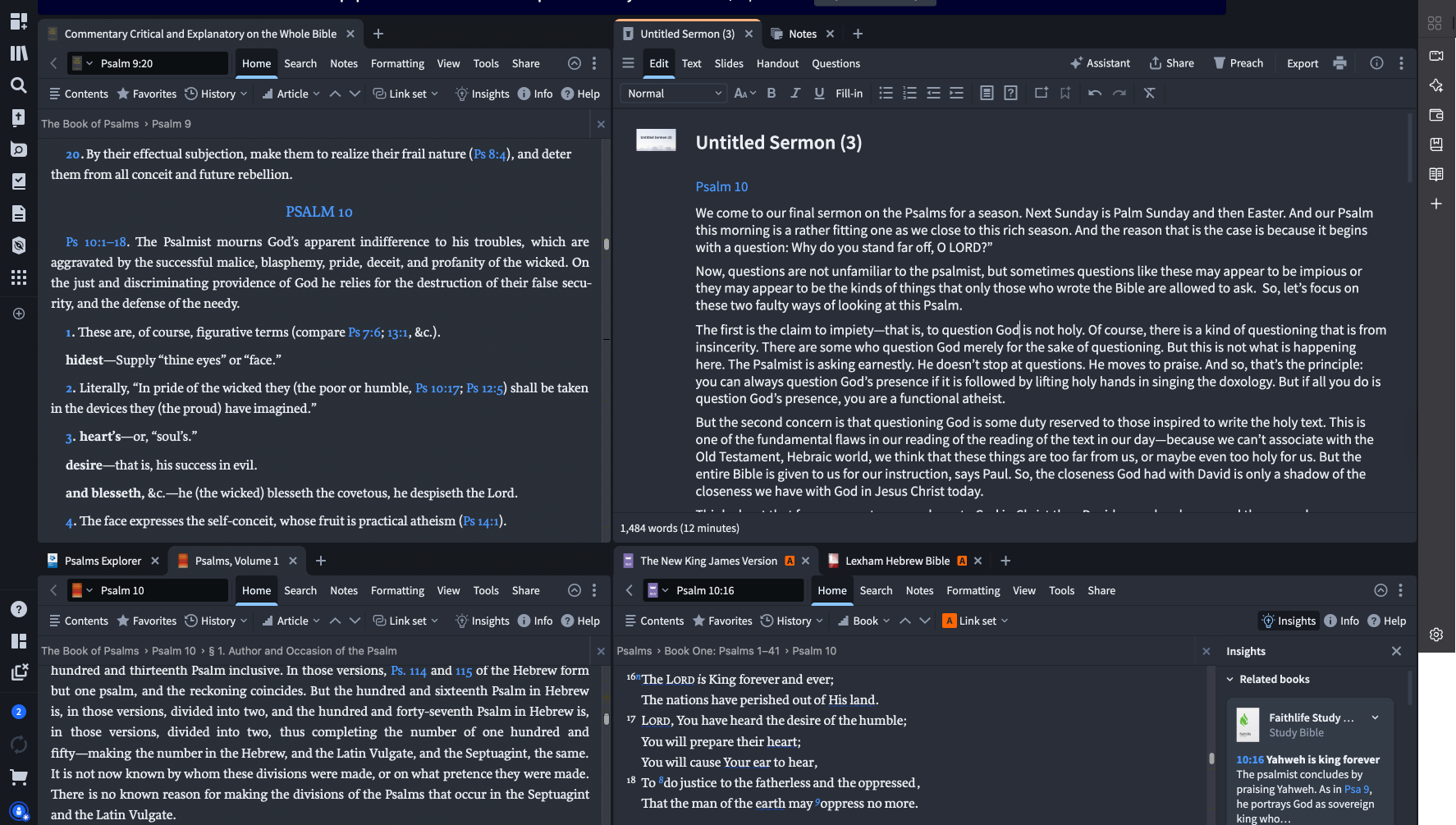
My sermons are all manuscripted, which has been an incredible boost to my writing over the years. It has helped me crystallize thoughts and shape the rhetorical dimension.
I need to commend heavy cream as a way of life, but nothing matched Amish Heavy Cream in Lancaster, PA. The saints purchased it just so I could savor the fat of sacrifices. May you own the cattle on a thousand hills!