

Lent is a season that slows us down long enough to examine the small things that reveal the true condition of the heart. Scripture often reminds us that great sins do not usually begin with great actions. They begin with small gestures, small habits, and small words. Proverbs 10:10–14 offers a kind of biography of good and evil through something that seems ordinary: the mouth.
Solomon shows us two kinds of people—the fool and the righteous—and the dividing line between them is often their speech.
The Schemes of the Fool
Our text begins with a striking image: “Whoever winks the eye causes trouble, but a babbling fool will come to ruin.” The fool is not merely someone who lacks intelligence. In the book of Proverbs, the fool is a moral category. He is someone who has mastered the art of evil.
Notice how subtle the description is. Solomon speaks of a man who “winks the eye.” This is not the wink of humor or affection. Literally, it is the compression of the eye—the gesture of someone quietly plotting his next move. The fool is restless in his scheming. His mind is constantly rehearsing what trouble he might cause next.
Such a person becomes known in the community. Parents instinctively steer their children away from him. His words start fires around him. His conversations are filled with manipulation, gossip, and disruption.
Yet Proverbs reminds us that evil has a boomerang effect. The babbling fool eventually comes to ruin. Every careless word eventually circles back. The trouble he creates for others eventually settles upon his own head.
Lent invites us to pause and ask a difficult question: What kind of words are we producing?
The Fountain of Life
Against the fool stands the righteous. Solomon writes: “The mouth of the righteous is a fountain of life, but the mouth of the wicked conceals violence.”
What an image—a fountain of life. Scripture frequently connects life-giving wisdom with speech. Solomon says that the teaching of the wise, the fear of the Lord, wisdom itself, and the speech of the righteous are all fountains of life.
Jesus echoes this same truth when He says that rivers of living water flow from the heart. The heart is the core of who we are, and our words eventually reveal what is truly there. We can manage appearances for a time, but the tongue eventually exposes the soul.
James describes the danger of the tongue in dramatic terms. It can stain the entire body and set the course of life on fire. Words have astonishing power. They can wound marriages, fracture friendships, destroy reputations, and divide communities.
But words can also bring healing and life. The righteous man’s speech refreshes others like clean water in a dry land. His words encourage, instruct, comfort, and correct with wisdom.
This is why Scripture repeatedly calls believers to bring their speech under the lordship of Christ. Lent reminds us that repentance often begins with the tongue.
The Long Work of Wisdom
Proverbs concludes with a picture of accumulation: “The wise lay up knowledge, but the mouth of a fool brings ruin near.”
The wise store up knowledge. They build it patiently over time. This language echoes the creation mandate in Genesis. Humanity was created to exercise dominion—to cultivate, build, and develop what God has given.
Wisdom follows that same pattern. It is stored, accumulated, and cultivated through years of listening, learning, reading, and receiving instruction.
The fool lives moment to moment, speaking whatever comes to mind. The wise man builds slowly. He listens more than he speaks. He gathers wisdom not only for himself but for the benefit of others.
This is one of the quiet goals of the Christian life. We accumulate wisdom so that we may pass it on. Our pursuit of wisdom becomes a kind of succession plan—an investment meant to bless others.
Lent reminds us that the Christian life is not built overnight. It is built slowly through repentance, humility, discipline, and grace.
And so the question remains before us: will our words burn like sparks in dry grass, or will they flow like a fountain of life?
The answer, as Proverbs reminds us, begins in the heart.
Notations
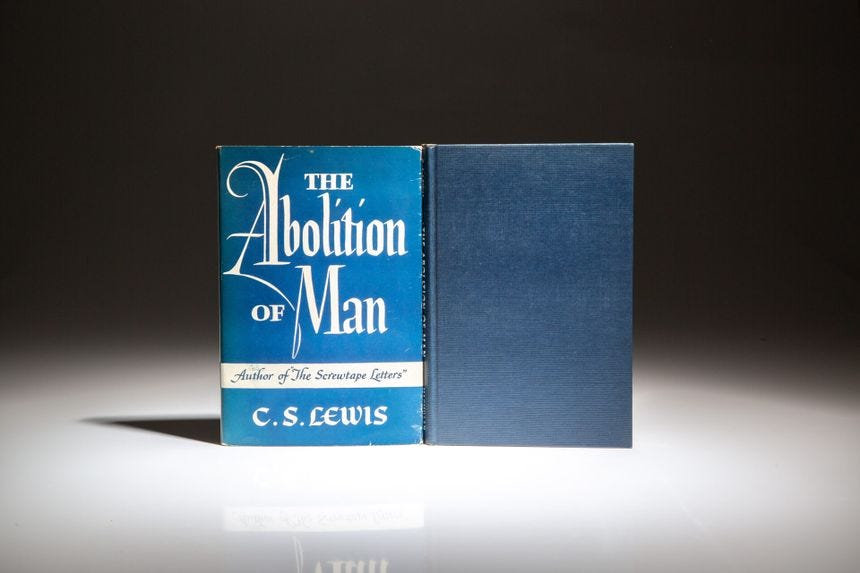
I listened to The Abolition of Man a couple of times this past week, and by the second time, I found myself overwhelmed by the sense of meaninglessness that occurs when the unbeliever suppresses the truth.
C. S. Lewis wrote The Abolition of Man as a warning about what happens when a society abandons objective moral order. His concern was not merely with education, but with the entire direction of modern culture. Lewis observed that many modern thinkers treat values as nothing more than personal feelings or social preferences. Instead of saying something is truly good or truly evil, they say only that they “feel” approval or disapproval toward it. When this happens, moral language is emptied of meaning.
Lewis argues that throughout history and across civilizations, there has existed a shared moral framework that he calls the Tao. This includes principles such as honoring parents, protecting the weak, telling the truth, and rewarding justice. These moral realities are not inventions of culture but reflections of the structure of the world itself. They are woven into the fabric of creation.
Modern education, Lewis argues, is quietly dismantling this framework. When teachers train students to believe that all moral judgments are merely emotional reactions, they remove the foundation for virtue. Yet society still expects courage, loyalty, and integrity from those same students. Lewis famously calls this contradiction “men without chests”—people whose intellect and appetites remain intact but whose moral formation has been hollowed out.
The result, Lewis says, is not liberation but manipulation. Once objective moral order is rejected, power fills the vacuum. A small class of “conditioners” begins shaping humanity according to their preferences, using science and technology as tools of control. Ironically, the attempt to conquer nature ends with some humans conquering others.
Lewis concludes that if the Tao is rejected entirely, humanity will ultimately abolish itself. A civilization that denies objective good and evil loses the very standards that make human dignity possible. Therefore, the task of education and culture is not to invent morality but to recover and preserve the moral order that already exists.
Adding to "the tongue" which reveals what comes from the heart, the keyboard also must be tamed.