

It’s time to make some observations about Michael O’Brien’s book. Next to Jayber Crow by Wendell Berry and The Name of the Rose by Umberto Eco, and a couple of others, this book has earned the Brito “top five ratings!”
I offer some observations about this work with tremendous hesitation. It’s not because I have reservations about the book, but it’s because I will have reservations about those who have yet to read it. I know. That sounds a little pretentious. Maybe the better word to express my regret is sadness—sadness for those who have not yet met this unpretentious man, named Josip Lasta.
But I also need to add that I am a charitable reader. And I am a charitable observer of humans. I work hard to see the best in people, and when they use their creative talents to speak eloquently about life, I tend to overlook minor nuances and personal habits and focus on the overarching glory of the thing. So, be charitable to my enthusiasm as I write some thoughts about this labor of love to humanity.
Like a Eulogy
Island of the World was a description of redemptive history. It read like a eulogy. Dust to dust…ashes to ashes. But the eulogy is a lengthy, well-defined biography of Josip. In fact, by the time the eulogizer ended his biography of the lean and tall Croatian, some of the attendees had died, because they too had lived in, under, and above Josip, like a sacramental offering.
Who is Josip? Josip is Joseph, who fled the flirtation of the American diplomat. Josip is David, who imparted wisdom. Josip is the widower, whose wife was found. He was the behemoth in Job who rose out of the waters with strength and glory. He was the aged man of Ecclesiastes whose body could no longer keep pace with his curiosity. He was the apostle to the weary and heavy-laden. Josip was all these things, but he was just ordinary. He was anonymous. He was convictional. He was popish, but not dismissive of Protestant ethos.
The book was over 800 pages long, though I spent most of it listening to and fro across the country—in planes, lounges, homes, gyms, pastoral visits, and more. Wherever I went, I listened. Whenever I thought I understood it, I was forced out of my logic.
O’Brien drew me to the earthiness of Josip’s childhood to the heavenliness of his religious conversion, and yet, it never felt trivial. The whole thing felt like a perfumed narrative. Yes. I could smell the countryside, the stench of prison camps, and the fish in his bathtub in Manhattan.
There is a lot to say, but I simply wish to state an existential reality: Josip set forth a path. He found things he thought he had lost forever, but he refused to let them go, crystallizing them in poetry. He carefully arranged in holy chiasms. Each one pierces the limits of emotions. He refuses to forsake the good in every endeavor. Each letter sent back to the U.S., each encounter with providential figures from his past. Each bullet fired and not fired (let the reader understand). Each swallow that flew into his window spoke to him. Each encounter with the crucified Christ. Well done, Josip! Whether you lived or not, I am thankful for the imaginative genius that made you alive for me, and for the many others who will listen to your story.
Notations
Endorsements
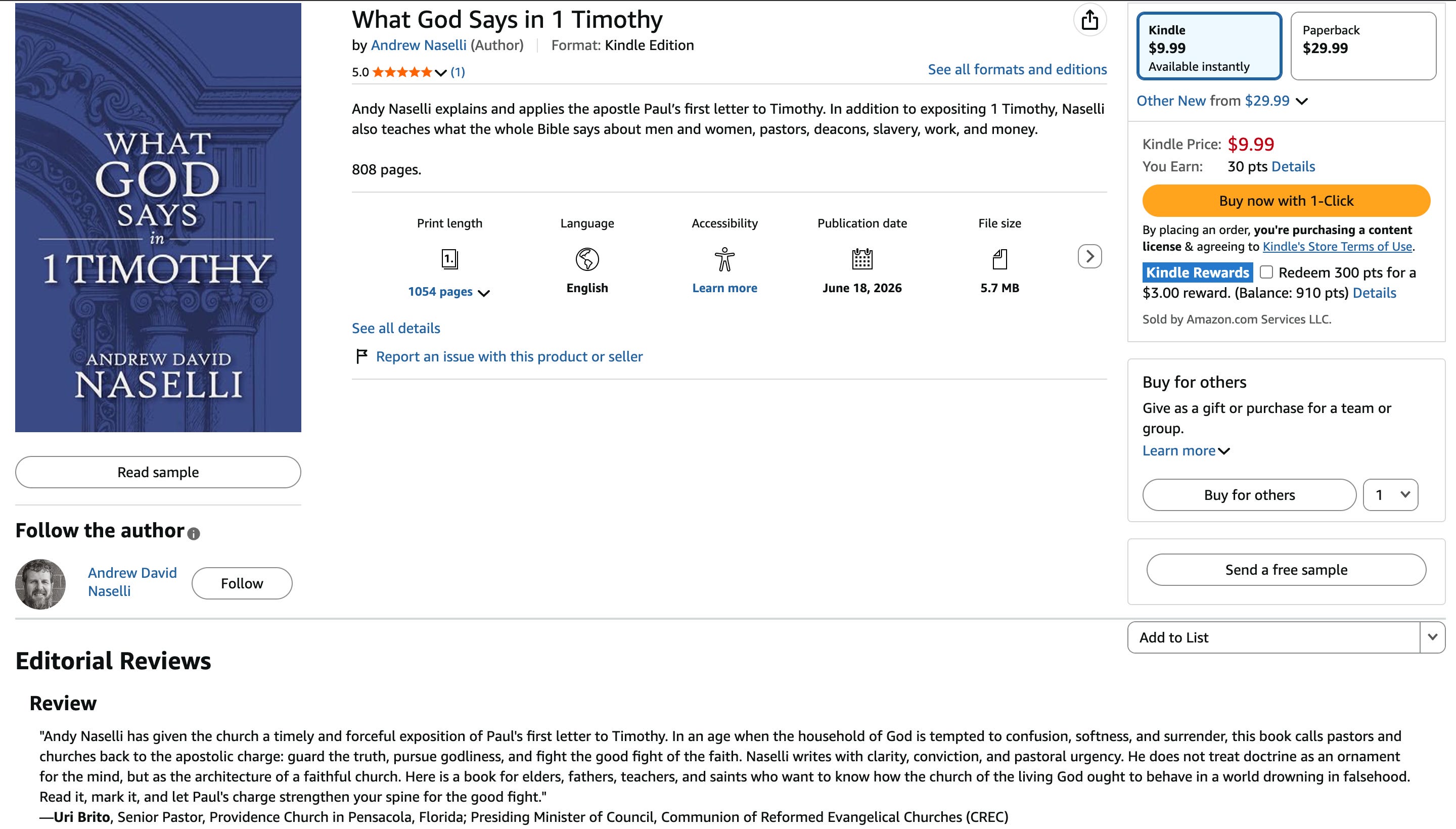
I am reaching middle age as a pastor and theologian. And I find myself writing endorsements for books cause that’s what aging pastors do, especially for friends. At this stage, I receive regular invitations to write something nice about new releases. I can’t take all the invites, but Andy Naselli is doing great work pastorally and academically. So, here are three cheers for his new commentary!
Notes on Reading
The whole affair of reading has me thinking that engaging in books is a community-forming exercise. They allow you to hear the wants and woes of others, and it builds “intellectual coalitions.”
The Church needs these coalitions to fight, to build, and to serve. We need the examples of Josips, Raskolnikovs, and Theos to teach us that life is exemplary; it’s imitative.
Books enable us to serve others with knowledge and insight by digging deep into the reservoir of our emotions. Sometimes, emotions we didn’t think we had, but we now know we needed. And it serves the body by urging others to tell their stories more compellingly.
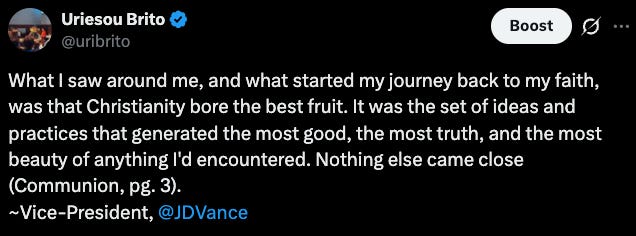
Vice President’s NEW BOOK
Books written by politicians are like the art of poison ivy. But methinks this is an exception. Vance’s Hillbilly Elligy was a masterpiece which likely put Trump in office, so I have begun working my way through the discovery of what makes JD, JD!
Just finished Island of the World. It was on my ‘to read’ shelf for a long time, but your words were the catalyst that made me finally sit down with it. I’m still processing it, as a soul experience. Begging my loved ones to read it and experience it with me.
I’m agree - great book and men reading together is a good thing!