

The book of Joel is a book about judgment and promise. It is like many of the other minor prophets. And if you were to sit down and read the 12 Minor Prophets, you would see a series of recurring themes. There would be a number of sins stressed again and again, defining Israel and her present condition.
But what’s unique about Joel is that he doesn’t lay out the particular sin he is addressing when he threatens judgment. Instead, he assumes you are in conversation with the other prophetic books. He presupposes that you know your Bible quite well.
Joel is so skilled in the prophets that his book is essentially a tapestry of quotations, allusions, and echoes from Isaiah, Jeremiah, Zephaniah, Ezekiel, and others. Joel is a prophet who is convinced that neutrality is a myth, and so he bathes his letter in judgment and promise language. These two themes fall under the category “The Day of the Lord.”
For Joel’s audience, the question is “On which side of the day do we want to stand?” There is a good day of the Lord, and then there is a bad day. What kind of day do you want? At the center of this dreadful day, however, Joel announces an open door. Judgment is approaching, but grace still speaks. And when grace speaks, it summons God’s people to return—not only to inward sentiments; it takes on bodily form.
“Yet even now,” declares the Lord,
“return to me with all your heart,
with fasting, with weeping, and with mourning;
13 and rend your hearts and not your garments.”
Return to the Lord your God,
for he is gracious and merciful,
slow to anger, and abounding in steadfast love;
and he relents over disaster.
The Day of the Lord is not experienced the same way by everyone. It depends on which side of God’s covenant you stand.
On one side, the Day of the Lord is slow to anger and abounding in steadfast love. But for those who refuse, the Day of the Lord looks like Portland weather—dreary, dark, uncertain, and with no prospect of sunshine.
The linchpin for determining what kind of day, or even what kind of future you want, is the character of God. We change like petals on a daisy. Some days, we love him, and some days, we love him not. But God is a God abounding in steadfast love. He does not change; there is no shadow of turning in him. Our trust comes from God’s unchanging promises.
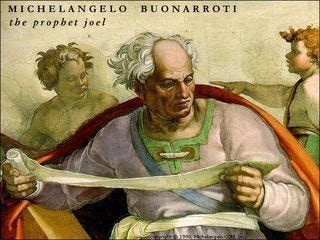
The key for Joel is to return to God with your heart. Don’t look inside yourself. Don’t look to special signs in the skies. Don’t look to gurus. Look to God. Go to him. In Joel, repentance is entering Lent with all your heart—turning away from sin and to the Savior.
For the Prophet, you enter into a repentant world, “with fasting, weeping, and mourning.” However they are interpreted, we know that fasting, weeping, and mourning are not the kinds of things unrepentant people do. If you fast, your body is needy; if you weep, your composure changes; if you mourn, you change your disposition. These are all action-themes.
Repentance turns night into day, Sodom to Jerusalem, valley to mountain. So, we must always walk intentionally through the valley of death. To be on the right side of the Day of the Lord means that it’s not business as usual, but business unusual—business done differently.
Joel describes the restoration of the land in the rich language of the prophets.
18 Then the Lord became jealous for his land
and had pity on his people.
19 The Lord answered and said to his people,
“Behold, I am sending to you
grain, wine, and oil,
and you will be satisfied;
and I will no more make you
a reproach among the nations.
Look at the promise for those who walk humbly: your land and garden will be established. But not only that, God is also sending you grain, wine, and oil. Bread is good. Wine is great. And oil is liquid gold. Oil anoints, oil fattens, oil adds flavor. It’s the one-two-three punch of glory God is promising.
What is Joel saying? Joel is pointing us to Easter Sunday! On Easter Sunday, our fasting turns to feasting; our weeping turns to laughter, and our mourning turns to celebration. On Easter Sunday, all the diligence we put into Lent will make sense, but more than that, it will be good for our souls and bodies. It will make the champagne taste even better.
So, don’t let your sins coat your tongue and stain your lips. Come and confess them in all seasons; come and tell our God that we want to be on the right side of the Day of the Lord. Come with weeping, so that your mouth may be filled with laughter. Come and embrace the prophetic word!
Nuntium
I will be with my old friends, Jeff Meyers and Steve Wilkins, in St. Louis in a few weeks.

Cancer Diary #4
I am in Nashville for two full weeks of speaking engagements and meetings before the CREC Council. I am exhausted, but not because of the cancer, simply because we have been traveling non-stop for the last three days to Jacksonville for consultations, then to Nashville totally around 18 hours in these last three days.
But I still owe you the diagnosis story. In my third installment, I concluded thusly:
The 30 minutes were up. They ushered me out. And then I opened my veins for another set of blood tests. Then, I left. I had to wait for results. I waited. I waited. I waited. Seven days and seven nights. Then I got that phone call on a Wednesday afternoon, and it changed everything.
That Wednesday in June, I finally received a phone call from my urologist’s office. But there was no charm in it. His assistant, without a trace of elegance, simply told me the doctor was out of town, stuck in an airport, but that he had sent her a message saying he wanted to see Uri Brito urgently— in two days.
I was aghast at her lack of decorum, and overwhelmed by her words. Apparently, something was so urgent that my stranded urologist had dispatched a message through his assistant, who then delivered it with the worst bedside manner humankind has ever witnessed. Well, I exaggerate to make the point of my precise sensation at that point. She could have said, “Sir, the doctor would like to go over your MRI results in two days,” or “Mr.: I’d like to confirm that you will meet the doc at the office on such-and-such a day.” But instead she chose anxiety-medication-level-discourse.
How on earth was I supposed to interpret her words? Surely she didn’t mean that, in 48 hours, the urologist was desperate to tell me the good news from my MRI. She spoke in apocalyptic terms on the phone. And anyone with sophomoric familiarity could read between the Shakespeare lines. This was a damn tragedy, O Titus Andronicus!
I looked at my wife and told her I think my doctor believes I have cancer. She looked distraught, hoping for another outcome. “No, I really think so.”
Now, in my line of work, I have walked with many people through cancer, and I have conducted and attended funerals with cancer patients lying in those coffins. So, the conversation about cancer already carried a nefarious ring to it. It seemed that I was falling into this ring of fire, a ring of fire, I tell ya.

I became rather pensive as I waited for my results. I don’t think I was very productive those days. I read and wrote, but I don’t remember what I read or wrote. It felt mechanical, without the ordinary oomph I bring to it. I kept my invisible Calvinist tattoos exposed so I could look at them and remember my Heidelberg Catechism. That stuff about comfort in life and in death. I told myself, “Time to stop reciting, and really believin’.”
My bride met me for the appointment. I was called in and waited. Somehow my doctor was quite upset at his assistant for one thing or another, and we had the privilege of listening to about 15 minutes of scolding. As you can imagine, the outside noise wasn't comforting. But after a while, we started laughing. It was quite the overture to the doc’s entrance.
He finally walked in. Fairly rushed, I tell you. Told a story or two about his unfortunate delay at the airport a few days earlier. And then, with the temperance of a hyena approaching its prey, plunged right into the matter.
“Well, I am glad we took an MRI. Your PI-RADS 5 lesion-the highest category of suspicion. It is very likely that you have cancer.”
I became numb as he began to talk about potential surgery, side effects, recovery, and what awaited me on the other side of removing my prostate. I listened carefully, but my mind was traveling well over the speed limit. My wife looked puzzled and inquired about some of the side effects of radical prostatectomy, and I calmly followed up. No, I wasn’t calm. I was just comfortably numb.
But then, said the man in white, “We can’t know for sure that you have cancer until we have a prostate biopsy.” At that moment, all the expectation that this was all a big misunderstanding was gone. “Now, how certain are you this is cancer?” I asked. He said, “98%." Now, in the statistical world, that’s what people say to avoid being sued. He could have said 100%, but that would be too certain, and medicine operates on high probability.
We left.
My wife was driving a separate vehicle. I told her that I needed to call my Session. They are my trusted friends and men to whom I give an account. They quickly accommodated my urgency; we did a conference call, and I gave them the news. There was always that pesky 2% that could fool us. But deep down I knew—the C word was here to stay.
We cried that night.