Note: You can find my cancer diaries here:
1. The Beginning of My Cancer Journey
4. 98% Cancer.
5. The Anesthesiologist and the Prostate Biopsy.
I am now on my 18th day of cancer treatment using Orgovyx as my ADT. It’s a small and quite expensive pill that lowers testosterone. This suppresses the cancer cells and provides a better outcome for men with higher-risk localized prostate cancer. But it also adds a host of tangible side effects. Thanks to a consistent regimen of strength training, supplements, and ketogenic meals (under 20 carbs a day), I’ve been able to maintain a steady exercise routine while avoiding major episodes of fatigue. Nevertheless, I have not escaped the hot flashes during sermons and regular office hours, and the insomnia has been fairly consistent. I am operating on little sleep, but God—in his kindness—continues to provide stamina.
Yesterday was the second Sunday when I was able to do everything expected of me, including two full liturgical services (including Word and Sacrament) and fellowship before and after. We still enjoyed a delightful meal with friends in the afternoon, and then led a book study at our home until 9:30 pm. It was a full Lord’s Day with four hours of sleep! I remain ever grateful, as a caffeinated Calvinist, that God formed me and not some imperfect deity. The Triune God is the One who gives and takes away. Blessed be his holy name!
I will continue on ADT for the foreseeable future, even as I undergo proton-radiation therapy in early January. I am praying that my MRI in December will show a favorable response to the treatment, a reduction of the visible tumor, and a regression of those nasty, hostile cells.
Spiritual Thoughts on Cancer
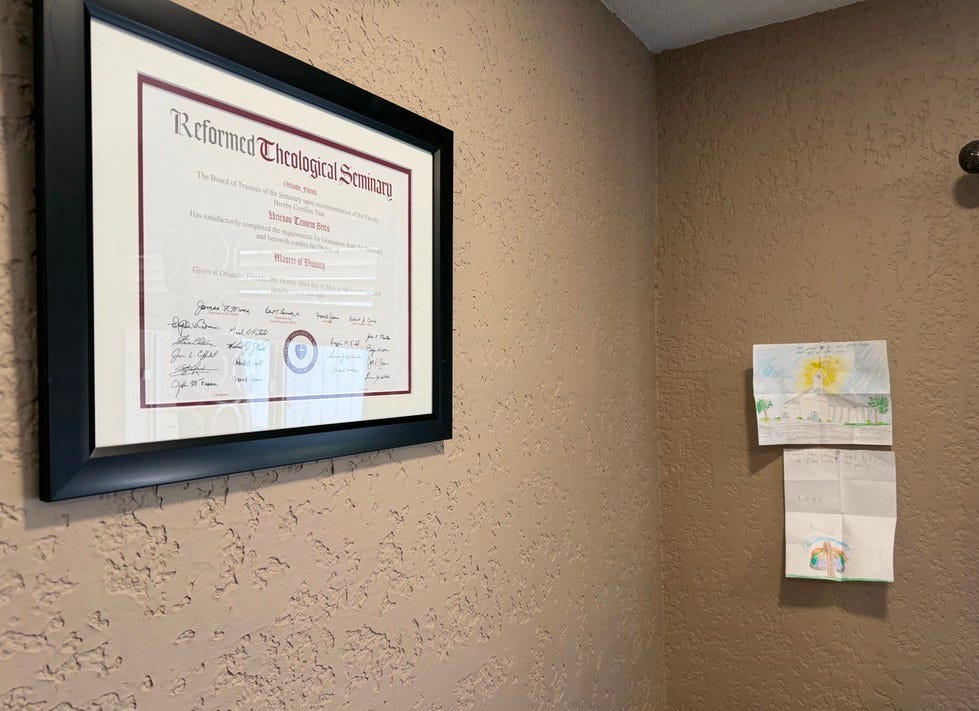
One of the great joys in my cancer treatment is to know that I have a multitude of people, including little people, praying for me. Some of those art pieces, or drawings, are stamped happily on my wall. They remind me that the prayers of righteous children avail much. It has been delightful to acquaint myself with my little parishioners through the lens of suffering. I realized that they, too, need to see their pastor suffering well. I am cognizant that there are over 200 of these humans in our congregation, and that, to borrow the words of that unique Minnesotan pastor, I don’t want them to see me wasting my cancer.
There is also an additional point that has struck me in these last few weeks from a visitor to our congregation. She found out about my cancer and reminded me of the words of Sarah Edwards, who, upon hearing of her husband’s death, said that she can now kiss the rod. I have been keeping that in the back of my mind as I meditate on the journey God has for me. I will embrace the providence of God over my life and will treat it tenderly as a gift.
My dear friend, Dr. Ben Merkle, who has been a fellow cancer companion in these last few months, wrote something quite unique about his experience:
Cancer has been an astonishing little blessing to me. I’m almost to the point of wanting to recommend it to others. Are you feeling a little sorry for yourself? Are you getting a little resentful and petty? Are you turning into a bit of an insufferable ingrate? Try cancer! Okay, I’m not quite there. To be clear, I still recommend against it. But we serve a God who works for the good to those that love him and are called according to his purpose. And I have tasted this goodness plentifully in ways that I don’t deserve. And so I am happily humbled.
I cannot but concur with his assessment. If cancer is my lot at this stage of life, let it remove any sense of self-pity and lead me to the humility of a servant under God’s righteous protection. To God be all glory forever and ever, amen!
Ecclesial Dogma vs. Practice
There is a distinction between what the Church taught dogmatically throughout history and what the Church has done practically. The Church spoke clearly on matters of dogma, encapsulated, for instance, in the Nicene-Constantinopolitan Creed. But the Church has not spoken definitively on various practical matters. Practices vary dramatically. Think of fasting and Easter observance. Or even postures in worship, such as kneeling or standing during Sunday prayers. In other words, the Church’s praxeology may differ externally, but her creed is always clear internally.
Examples abound. But a couple will suffice. For centuries, churches met divided between men and women. Men sat on one side and women on the other. The seating arrangement preserved sexual distinctions. The Catholic church ceased such practice in the 20th century, though the Coptic churches in North America and Syriac congregations throughout Europe still continue to practice.
Additionally, women also covered their heads with some cloth/veil in many of our Reformed congregations, though it does not seem to receive any wide attention in Reformed Councils. Some, like Theodore Beza—Calvin’s successor—treated certain ecclesiastical practices, including headcovering, as matters subject to change. In the 1591 Propositions and Principles of Divinity, it reads: “As for the things which appertain to outward rites, they in consideration of diverse circumstances ... may be changed.”
Furthermore, history testifies that there were distinctions in how and when they were worn and who the recipients should be. In fact, the practice among Roman Catholics was only codified in 1917. The practice fell into disuse and was not retained in the revised 1983 code. Many Bible-believing traditions, even those once devout to such practices, have ceased these practices individually and corporately in the last 120 years.
These are practices that go through various changes within the Church as interpretational paradigms shift and new research is made. It does not mean that newer is better, but it does mean that every practice needs to be judged by the Holy Scriptures. And so, even common practices undergo alterations and adaptations as the Church matures in its understanding.
But what does not change is the ever-blessed creed of the church worldwide. The dogma pertaining to sound doctrine is taught, believed, articulated, and defended throughout history. These settled doctrines should not be treated as mere practices to be renewed at the latest ecclesiastical gathering or to be sources of public dispute in the social media ecosystem.
Dogma is settled business! The deity of Jesus and the Spirit as Lord and giver of life is exegetically irrefutable and ought not to be trifled with at any level. There may be textual discussions about which text most clearly testifies to its truth, but the doctrine is dogmatically sound and must be affirmed and confessed when the Church gathers.
The Church may differ in secondary or tertiary practices, but she cannot be tossed by every wind of doctrine. She must be a refuge in an age of relativism and doctrinal lego-building. She must be the steady voice in a sea of theological confusion.
Notations
Leithart’s upcoming work on Revelation is easy, accessible, and a remarkable summary of decades of theological and biblical study. He has already published one of the largest commentaries on Revelation in history. And now, he offers us a delightful appetizer. It’s a real honor to endorse this work. You can pre-order now.